Introduction
Addressing a paradox that is frequently encountered in daily clinical practice and is confusing for both patients and healthcare professionals is the most effective starting point for understanding the true nature of pain. An individual who is unable to move due to severe low back pain, whose daily activities are disrupted and whose quality of life is significantly reduced, may be told that their spine appears “perfect for their age” in the most advanced magnetic resonance imaging (MRI) examinations. On the other hand, it is extremely common to incidentally detect multiple disc herniations, spinal canal narrowing, or degenerative changes in imaging of another individual who has never experienced low back pain in their life.[1, 2] This situation raises the following fundamental question: If pain is only a result of tissue damage, how is it that those with damage do not feel pain, while those whose tissues appear healthy can suffer severe pain? The scientific literature answers this question by stating that pain is not “psychological” (i.e., imaginary), yet it is also not only “physical” (i.e., solely dependent on tissue damage); rather, it is a complex interaction of biological, psychological, and social factors acting on the nervous system.[3, 4, 5]
Summary: A New Story of Pain
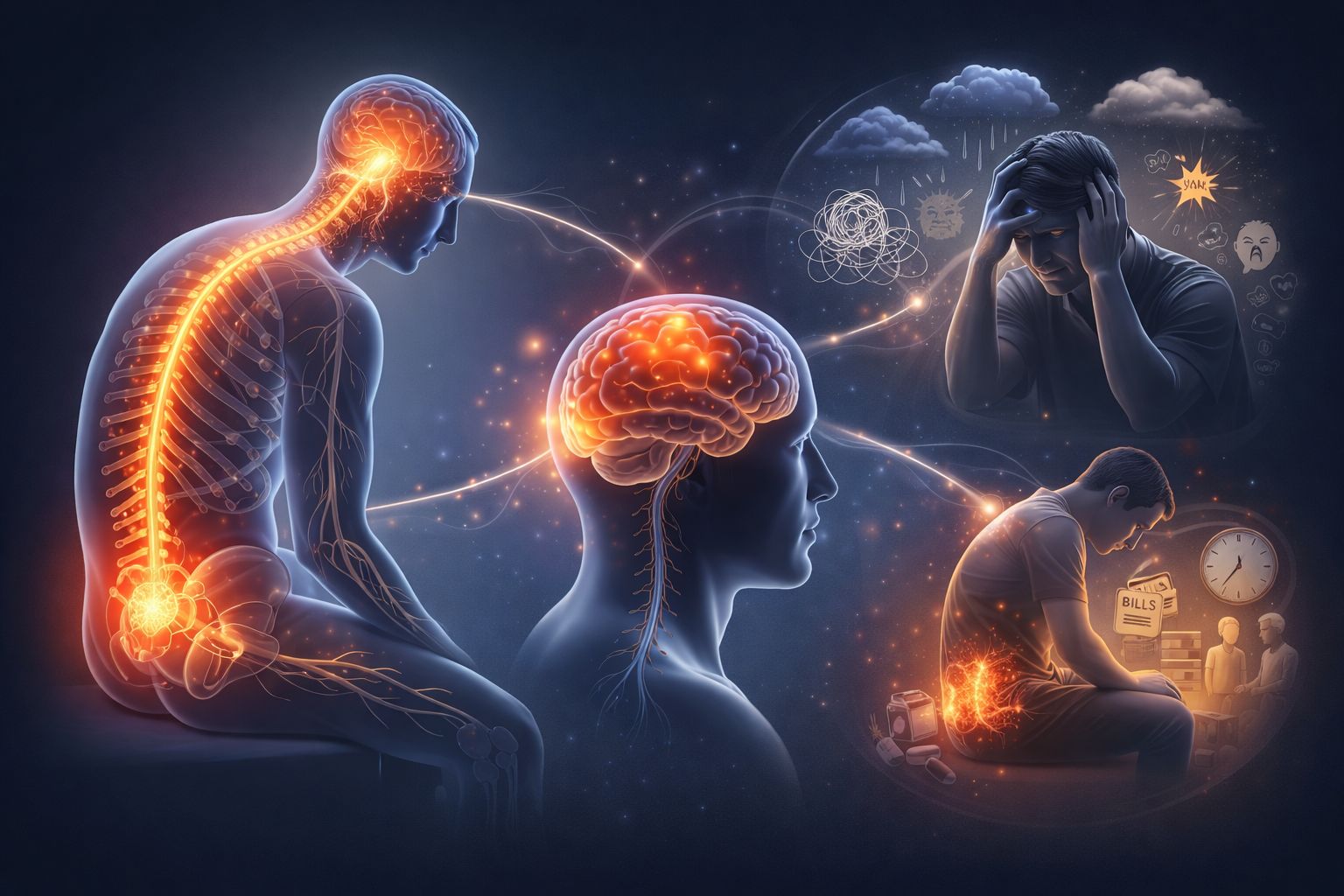
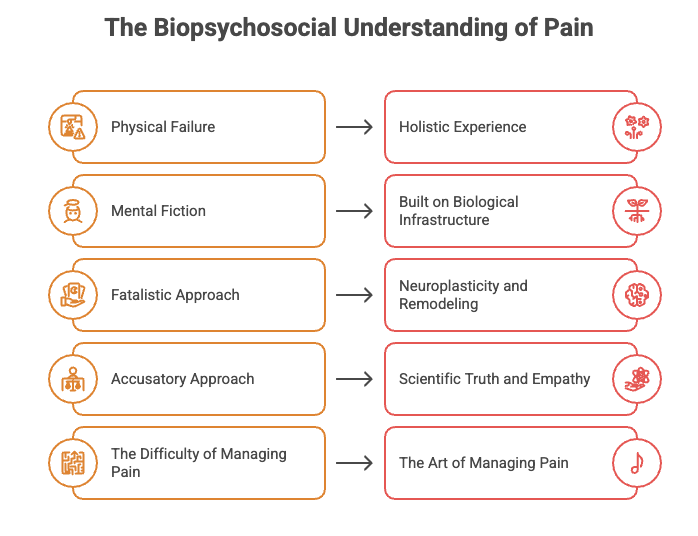
Pain is neither solely a physical malfunction nor merely a mental construct; it is a holistic life experience built upon a biological foundation, blended with psychological state, and shaped within a social environment. Tissue damage may send a “danger signal,” but the authority that determines whether this signal turns into “pain” is the brain. Modern science shows us that herniations or degenerative findings seen on MRI are not destiny; our nervous system is flexible (neuroplasticity) and can be reorganized with appropriate education, movement, and support.[5, 27, 34]
Blaming a patient with pain or saying “it is all in your head” is contrary to scientific reality. Pain is always real and always has a counterpart in the nervous system. A successful recovery process is possible through a scientifically grounded biopsychosocial approach that considers the patient as a whole, taking into account their fears, expectations, and life conditions.[4, 17] Managing pain is the art of reteaching the nervous system that it is “safe.”
Paradigm Shift in the Definition of Pain: IASP 2020 Revision
The International Association for the Study of Pain (IASP) published its new definition in 2020, recognizing pain not merely as a medical symptom but as a multidimensional experience. While the previous definition used since 1979 closely associated pain with tissue damage, the revision made in light of current scientific evidence defines pain as follows: “An unpleasant sensory and emotional experience associated with, or resembling that associated with, actual or potential tissue damage”.[3, 6] The inclusion of the expression “resembling” formally acknowledges that even in the absence of a concrete tissue injury, the pain experienced by the individual has a neurobiological reality.[7, 8]
Experts within the IASP added six key notes to this definition in order to preserve the subjective nature of pain and reinforce respect for patient self-report. These notes emphasize that pain is not merely a sensory signal but a process learned throughout life and processed at every level of the nervous system.[6]
Note No Core Concept Clinical and Scientific Explanation 1 Personal Experience Pain is always a personal experience; it is influenced to varying degrees by biological, psychological, and social factors.[6, 9] 2 Distinction from Nociception Pain and nociception (neural transmission) are different phenomena. Pain is not solely the result of activity in sensory neurons.[7, 8] 3 Learned Concept Individuals learn the concept of pain through life experiences, and this process begins in childhood.[6, 9] 4 Report and Respect A person’s report of an experience as pain should be respected; pain is always what the individual says it is.[6, 9] 5 Adaptive and Harmful Role Although pain generally has a protective (adaptive) role, when it becomes chronic, it can have destructive effects on functionality and psychological well-being.[6, 8] 6 Diversity of Communication Verbal expression is only one way; non-verbal individuals or infants can also experience pain.[3, 7]
One of the driving forces behind this revision is the activism that developed in response to medical errors in periods when infants like Jeffrey Lawson were operated on without anesthesia. The scientific community now accepts as a consensus that individuals who cannot communicate also experience pain and that this pain cannot be measured solely by tissue damage.[7, 9]
Nociception and Pain: The Difference Between a Danger Signal and Pain
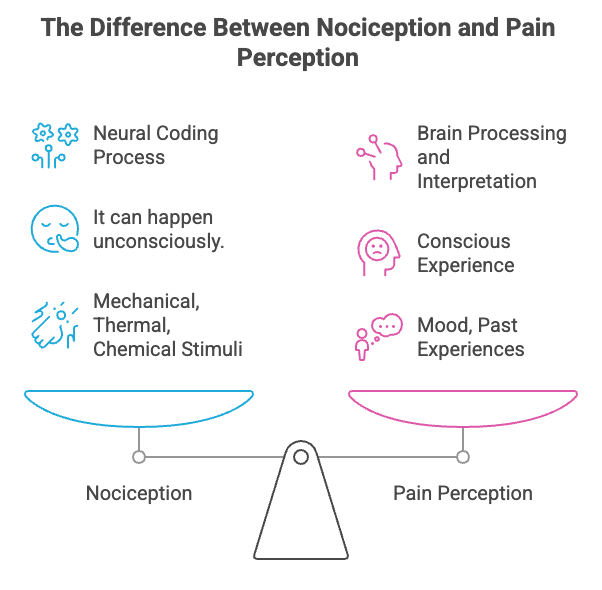
One of the most critical distinctions in pain science is the difference between nociception (nociceptive activity) and the perception of pain. Although these two terms are often used interchangeably, the relationship between them is similar to that between “electric current and the projection of an image on a screen.” Nociception is the process by which nociceptors (danger detectors) in the peripheral nervous system detect potentially harmful mechanical, thermal, or chemical stimuli and transmit this information to the central nervous system (spinal cord and brain).[8, 10] Nociception is entirely a neural encoding process and can occur outside of the individual’s conscious awareness.[11]
Pain, on the other hand, is the “unpleasant experience” that emerges after these nociceptive signals reach the brain and are processed and interpreted in various brain regions.[8, 11] The brain does not evaluate the incoming danger signal solely based on its intensity; it filters it through factors such as the individual’s current emotional state, previous similar experiences, perceived environmental safety at that moment, and expectations about the future.[12, 13] If the brain interprets the incoming signal as a “threat,” it produces the output of “pain” in order to protect the body. Conversely, while a patient under general anesthesia may exhibit nociceptive responses (such as increased blood pressure or elevated heart rate) to a surgical incision, pain is not experienced because the brain does not generate a “conscious perception.”[8] This demonstrates that although nociception may be necessary for pain, it alone cannot explain pain.[14]
The Tissue Damage Paradox and Imaging Findings
One of the major misconceptions of the biomedical model is the assumption that the severity of pain is directly proportional to the extent of tissue damage. However, large-scale systematic reviews conducted by Brinjikji et al. (2015) have demonstrated how common spinal degeneration is even in a healthy population with no pain.[1, 2]
Age Group Disc Degeneration (Asymptomatic %) Disc Bulge (Asymptomatic %) Disc Protrusion (Asymptomatic %) Annular Tear (Asymptomatic %) 20 37 30 29 19 30 52 40 31 20 40 68 50 33 22 50 80 60 36 24 60 88 69 38 25 70 93 77 40 27 80 96 84 43 29
In light of these data, it is observed that among 100 healthy individuals aged 50, 80 have disc degeneration and 60 have disc bulging, which is considered an early stage of herniation.[1, 2] If these findings are present at such high rates in asymptomatic individuals, the detection of these findings in a person with pain may not always represent the “sole and true cause” of the pain. Therefore, imaging results must always be evaluated together with the patient’s clinical presentation and life story.[1, 15, 16] Modern medicine no longer considers these findings solely as “disease” entities.
Biopsychosocial Model: The Three-Dimensional Nature of Pain
When pain cannot be explained solely by tissue damage, the “Biopsychosocial Model,” proposed by Engel in 1977 and now considered the gold standard in modern pain science, comes into play.[4, 17] This model defines pain as a dynamic interaction of biological events, psychological states, and the social environment.[4, 18]
Biological Layer (Bio)
Represents the physical origins of pain. This is not limited to bone fractures or muscle tears; it also includes genetic makeup, neurochemical releases, inflammatory processes, and the transmission speed of the nervous system.[19, 20] Peripheral sensitization that occurs after surgical procedures or injuries leads to a decrease in pain threshold due to the release of ATP, glutamate, and cytokines in the damaged area.[19]
Psychological Layer (Psycho)
Encompasses the cognitive and emotional responses of the individual to pain. Catastrophizing, defined as the belief that the outcome of pain will be very bad, is one of the strongest predictors of pain severity and disability.[12, 21] Anxiety, depression, fear-avoidance behaviors, and past traumas amplify pain perception by weakening the brain’s pain modulation systems.[4, 13]
Social Layer (Social)
Includes the individual’s environment, job satisfaction, family support, and socioeconomic status.[7, 22] For example, an individual who is under stress at work and has conflicts with their supervisor has a significantly higher risk of their back pain becoming chronic compared to someone with strong social support.[23] Cultural beliefs are also important social factors that determine how pain is expressed and how much it is “tolerated.”[5, 24]
Misinterpretation of the Concept of “Psychological Pain” and Reality
In society and even within some healthcare disciplines, labeling pain without a clear physical cause as “psychological pain” creates the false perception that the patient is “making it up” or that the pain is “not real.”[5, 25] However, modern neuroscience emphasizes that pain is always a real biological process produced by the brain. Psychological factors (such as stress and anxiety) do not “create” pain; they “turn up the volume” of the nervous system.[5]
The emotional component of the pain experience, referred to as “unpleasantness,” is processed in regions such as the anterior cingulate cortex (ACC) and the insula within the brain’s limbic system.[13, 26] These regions are also associated with social exclusion, sadness, and anxiety. Therefore, the low back pain experienced by a person under emotional stress is as real as pain caused by tissue damage, because the brain uses the same neural networks to process these signals.[13] Saying “psychological” does not mean “imaginary”; it means that the nervous system is modulated by emotional and cognitive filters.[12, 14]

Central Sensitization: Hyper-Responsiveness of the Nervous System
One of the most important mechanisms underlying chronic pain is “Central Sensitization.” This condition is defined as the increased responsiveness of nociceptive neurons in the central nervous system (spinal cord and brain) to even subthreshold stimuli that would not normally produce pain.[27, 28, 29] Once the nervous system becomes sensitized, pain becomes independent of tissue healing.
The neurobiological processes of central sensitization include:
- Increased Excitability: Synaptic transmission between neurons becomes facilitated, and a phenomenon called “wind-up” occurs, in which pain perception progressively increases even without an increase in stimulus intensity.[20, 27]
- Neuroimmune Interaction: Microglia and astrocytes in the brain become activated and release inflammatory cytokines, creating a “vicious cycle” that maintains neural sensitivity.[20, 26]
- Loss of Inhibition: The brain’s top-down endogenous pain inhibitory mechanisms (opioid and noradrenergic pathways) become weakened.[20, 29]
This condition has led to the emergence of a new category of pain called “Nociplastic Pain.” In conditions such as fibromyalgia, chronic fatigue syndrome, and irritable bowel syndrome, the widespread pain experienced despite the absence of tissue damage or nerve injury is due to the nervous system.
The Neural Impact of Stress, Anxiety, and Past Experiences
The nervous system functions like a recording device, storing every past negative experience for “threat analysis.” Traumatic experiences in the past can strengthen the connections between brain regions such as the amygdala and the prefrontal cortex, making the individual more vulnerable to pain.[13, 26] Cortisol and other stress hormones released during stress can increase sensitivity around nerve sheaths, activating even “silent nociceptors.”[19, 30]
Expectations also have a profound influence on pain. A positive expectation that a treatment will relieve pain (placebo) can trigger the brain to release its own opioids, whereas fear that pain will worsen (nocebo) can negate the effects of even analgesic medications.[13] This represents the direct impact of mental processes on biological outcomes.
Clinical Implications: New Horizons in Physiotherapy and Patient Management
The multidimensional nature of pain has necessitated a shift in treatment approaches from purely “mechanical interventions” to “nervous system management.” Modern physiotherapy not only focuses on strengthening muscles but also aims to “reset” the patient’s perception of pain.
Pain Neuroscience Education (PNE)
PNE is the process of explaining to the patient, based on scientific evidence, the biology of pain, how the nervous system functions like an alarm system, and the disconnect between tissue damage and pain.[31, 32] Studies show that when patients understand their pain, their fear decreases, which in turn reduces the perceived threat within the nervous system and leads to a decrease in pain intensity.[31, 33]
Graded Activity and Exposure
For patients who avoid movement due to “fear of harm,” movement must be taught by convincing the brain that it is safe. Graded exercise programs aim to gradually expand tolerance limits without overstimulating the nervous system.[12, 31] The goal here is not only the muscular structure but also changing the brain’s “threat evaluation” related to movement.[34]
Biopsychosocial Rehabilitation
The most successful outcomes in chronic pain management are achieved through a multidisciplinary approach in which physiotherapists, psychologists, and physicians work in coordination.[35, 36] Cochrane meta-analyses emphasize that biopsychosocial-based rehabilitation is far more effective in reducing pain and facilitating return to work compared to standard physical treatments or purely surgical approaches.[35, 36]
References
- Systematic Literature Review of Imaging Features of Spinal Degeneration in Asymptomatic Populations – PMC, https://pmc.ncbi.nlm.nih.gov/articles/PMC4464797/
- Systematic literature review of imaging features of spinal degeneration in asymptomatic populations – PubMed, https://pubmed.ncbi.nlm.nih.gov/25430861/
- This is not the end: A long‐awaited update of the definition of pain – PMC – NIH, https://pmc.ncbi.nlm.nih.gov/articles/PMC8975191/
- Evaluating Psychosocial Contributions to Chronic Pain Outcomes – PMC – NIH, https://pmc.ncbi.nlm.nih.gov/articles/PMC6067990/
- The Science of Pain – HealthCentral, https://www.healthcentral.com/pain-management/science-of-pain
- The Revised IASP definition of pain: concepts, challenges, and …, https://pmc.ncbi.nlm.nih.gov/articles/PMC7680716/
- Revisions to the IASP definition of pain—What does this mean for children? – PMC, https://pmc.ncbi.nlm.nih.gov/articles/PMC8975187/
- Nociception versus Pain | Pain Management Education at UCSF, https://pain.ucsf.edu/understanding-pain-pain-basics/nociception-versus-pain
- Don’t tell me, show me: Reactions from those with lived experience to the 2020 revised IASP definition of pain – PMC, https://pmc.ncbi.nlm.nih.gov/articles/PMC8975204/
- Pain or nociception? Subjective experience mediates the effects of acute noxious heat on autonomic responses – PMC, https://pmc.ncbi.nlm.nih.gov/articles/PMC5901905/
- Measuring pain and nociception: Through the glasses of a computational scientist. Transdisciplinary overview of methods – Frontiers, https://www.frontiersin.org/journals/network-physiology/articles/10.3389/fnetp.2023.1099282/full
- Impact of Psychological Factors in the Experience of Pain – Oxford Academic, https://academic.oup.com/ptj/article/91/5/700/2735743
- Cognitive and emotional control of pain and its disruption in chronic …, https://pmc.ncbi.nlm.nih.gov/articles/PMC4465351/
- Nociplastic pain: exploring the concept and ongoing discussions – PMC, https://pmc.ncbi.nlm.nih.gov/articles/PMC11965995/
- Imaging features of the aging spine – PMC – NIH, https://pmc.ncbi.nlm.nih.gov/articles/PMC8297484/
- MRI Findings of Disc Degeneration are More Prevalent in Adults with Low Back Pain than in Asymptomatic Controls: A Systematic Review and Meta-Analysis – PMC, https://pmc.ncbi.nlm.nih.gov/articles/PMC7964277/
- BİYOPSİKOSOSYAL YAKLAŞIM VE GELİŞİM SÜRECİ BIOPSYCHOSOCIAL APPROACH AND DEVELOPMENT PROCESS – DergiPark, https://dergipark.org.tr/tr/download/article-file/1240113
- Pain – The basic concepts – RACGP, https://www.racgp.org.au/clinical-resources/clinical-guidelines/key-racgp-guidelines/view-all-racgp-guidelines/drugs-of-dependence/part-c2/pain-the-basic-concepts
- Tissue Injury and Related Mediators of Pain Exacerbation – PMC, https://pmc.ncbi.nlm.nih.gov/articles/PMC3849785/
- Neuromodulatory Signaling in Chronic Pain Patients: A Narrative Review – MDPI, https://www.mdpi.com/2073-4409/14/17/1320
- Psychosocial factors and their role in chronic pain: A brief review of development and current status – PMC, https://pmc.ncbi.nlm.nih.gov/articles/PMC1151654/
- Psychological Factors Influencing Pain Intensity Perception: A Qualitative Study on Canadian Patient Insights – KnE Publishing, https://publish.kne-publishing.com/index.php/JIMC/article/view/19535
- The biopsychosocial factors associated with development of chronic musculoskeletal pain. An umbrella review and meta-analysis of observational systematic reviews – PMC, https://pmc.ncbi.nlm.nih.gov/articles/PMC10984407/
- The Perseverance Loop: The Psychology of Pain and Factors in Pain Perception, https://www.medcentral.com/psychiatry/cbt/perseverance-loop-psychology-pain-factors-pain-perception
- Nociplastic pain and central sensitization in patients with chronic pain conditions: a terminology update for clinicians – PMC, https://pmc.ncbi.nlm.nih.gov/articles/PMC10314229/
- Chronic Pain: Structural and Functional Changes in Brain Structures and Associated Negative Affective States – PMC, https://pmc.ncbi.nlm.nih.gov/articles/PMC6650904/
- Central Sensitization in Chronic Pain Conditions: Mechanisms, Clinical Implications, and Treatment Strategies – Preprints.org, https://www.preprints.org/manuscript/202503.1506
- CENTRAL SENSITIZATION IN CHRONIC PAIN: NEUROPHYSIOLOGICAL MECHANISMS AND CLINICAL IMPLICATIONS | International Journal of Innovative Technologies in Social Science, https://rsglobal.pl/index.php/ijitss/article/view/4428
- Central Sensitization and Pain: Pathophysiologic and Clinical …, https://pmc.ncbi.nlm.nih.gov/articles/PMC10716881/
- Central Sensitization: When It Is Not “All in Your Head” | AAFP, https://www.aafp.org/pubs/afp/issues/2023/0100/curbside-central-sensitization.html
- Effectiveness of Pain Neuroscience Education in Physical Therapy …, https://pmc.ncbi.nlm.nih.gov/articles/PMC12191368/
- The effectiveness of pain neuroscience education in people with chronic non-specific low back pain: An umbrella review with meta-analysis – PubMed, https://pubmed.ncbi.nlm.nih.gov/41005108/
- Effectiveness of Pain Neuroscience Education in Physical Therapy: A Systematic Review and Meta-Analysis – PubMed, https://pubmed.ncbi.nlm.nih.gov/40563828/
- Effectiveness of pain neuroscience education, motivational interviewing and cognition targeted exercise therapy in patients with – BMJ Open, https://bmjopen.bmj.com/content/bmjopen/15/2/e087788.full.pdf
- Multidisciplinary biopsychosocial rehabilitation for chronic low back pain: Cochrane systematic review and meta-analysis – PubMed, https://pubmed.ncbi.nlm.nih.gov/25694111/
- Multidisciplinary biopsychosocial rehabilitation for chronic low back pain: Cochrane systematic review and meta-analysis – PMC, https://pmc.ncbi.nlm.nih.gov/articles/PMC4353283/