Introduction: Is Movement Harmful in Lymphedema?
For decades, one of the greatest dilemmas faced by individuals diagnosed with lymphedema and the healthcare professionals guiding them has been the limits of physical activity. The question, “Will my swelling increase if I use my affected arm or leg?” led to a predominantly protective and restrictive approach in lymphedema management for a long time.[1, 2] Traditional clinical advice encouraged patients to avoid heavy lifting, repetitive movements, and strenuous activities, significantly restricting their quality of daily life.[1, 3] However, extensive clinical studies and systematic reviews conducted over the past two decades have completely transformed this “inactivity” paradigm. Current scientific evidence proves that a controlled and progressive exercise program not only does not increase the risk of lymphedema, but is also a fundamental component in reducing symptoms, preserving tissue health, and improving functional capacity.[4, 5, 6]
Lymphedema is a chronic and progressive condition that occurs when the transport capacity of the lymphatic system is insufficient to manage the interstitial fluid load.[7, 8] This insufficiency may develop due to surgical removal of lymph nodes, radiation-induced tissue damage, infections, or trauma.[9, 10] Avoiding movement creates a vicious cycle by leading to weakening of skeletal muscles, reduced joint range of motion, and increased body weight, all of which further impair lymph flow.[3, 11]
Summary: Short, Clear, and Practical
Living with lymphedema does not mean a life full of limitations; on the contrary, a conscious and controlled active lifestyle is the best treatment method.
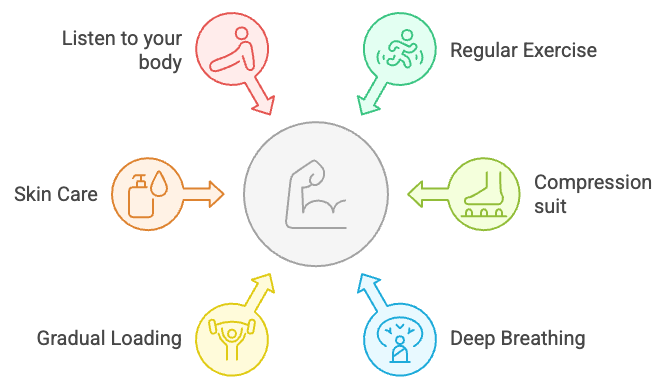
Actionable Golden Rules:
- Movement is Life: Regular exercise can increase your lymph flow up to 6 times. Never remain inactive.[11, 14]
- Compression Support: Always wear your compression garment, your “armor,” during exercise.[13, 20]
- Start with Breathing: Every morning and before every exercise session, activate your lymphatic pathways with 5 minutes of deep diaphragmatic breathing.[15, 18]
- Slow and Gradual: Follow the principle of “little and often.” Instead of overloading in one day, prefer consistent and light loading every day.[2, 28]
- Care for Your Skin: Clean it daily, moisturize it, and protect it like a shield against injuries.[37, 39]
- Listen to Your Body: If you feel increased swelling, heaviness, or tightness, rest and elevate the limb. If it does not improve, consult your specialist.[8, 30]
Lymphedema management is possible not through fear, but through knowledge and controlled movement. Scientific evidence shows that individuals who understand their limits and progress gradually live much more comfortable and independent lives.
Physiological Effects and Mechanisms of Exercise on Lymphatic Circulation
Unlike the circulatory system, the lymphatic system does not use the heart as a central pump. The transport of lymph fluid from peripheral tissues to the venous system largely depends on external mechanical factors and the intrinsic contractile dynamics of lymph vessels.[12, 13] Physical activity optimizes lymphatic drainage through several different biomechanical and physiological pathways.
Skeletal Muscle Pump and Lymphangion Activation
The basic functional unit of lymphatic vessels, the “lymphangion,” has the ability to contract rhythmically (intrinsic pumping) thanks to the smooth muscle cells in its walls. However, the efficiency of this intrinsic mechanism increases dramatically when supported by external pressure generated by dynamic contraction of surrounding skeletal muscles.[11, 14] During exercise, the shortening and thickening of muscles apply periodic pressure to the tissue surrounding lymph vessels. This “milking” effect allows one-way valves in lymph capillaries to open and pushes the fluid centrally. Scientific studies have shown that the lymph clearance rate during exercise is three to six times higher than at rest.[14, 15] Movements in which the muscle reaches its maximum shortening distance have been clinically confirmed as the most effective method for lymph propulsion.[14]
The Role of the Thoracic Duct and the Respiratory Pump
A large portion of the body’s total lymph fluid is transported via the thoracic duct (ductus thoracicus), which begins at the cisterna chyli below the diaphragm and drains into the vein under the left clavicle.[16, 17] The flow within this duct is directly influenced by pressure changes within the thoracic and abdominal cavities during respiration. As the diaphragm contracts and moves downward, intra-abdominal pressure increases while negative pressure is created within the thoracic cavity.[18, 19] This pressure gradient enables lymph fluid to be “suctioned” upward from the abdominal region into the low-pressure thoracic duct.[15, 18] This physiological fact explains scientifically why every exercise program should begin with deep diaphragmatic breathing.
Mechanism Table
| Mechanism | Physiological Effect | Result |
|---|---|---|
| Skeletal Muscle Contraction | Creates external pressure on lymph vessels | Pumping rate of lymphangions increases 3–6 times |
| Diaphragmatic Breathing | Creates negative pressure in the thoracic duct | Accelerates return of abdominal lymph fluid to the venous system |
| Cardiovascular Adaptation | Increases blood flow and capillary filtration | Balances interstitial fluid volume and improves protein transport |
| Soft Tissue Mobility | Stretches skin and fascia | Stimulates anchoring filaments in lymph capillaries, facilitating fluid entry |
Safety of Exercise and Its Role in Risk Reduction
Clinical literature agrees that exercise does not trigger lymphedema; on the contrary, when applied correctly, it acts as a protective shield. The International Society of Lymphology (ISL) and Cochrane reviews state that controlled physical activity does not increase limb volume or the risk of flare-ups.[20, 21, 22]
Risk Analysis in Cancer-Related Lymphedema
A systematic meta-analysis has shown that the risk of developing cancer-related lymphedema (CRL) is 29% lower in individuals who exercise compared to those who do not (Relative Risk RR = 0.71).[23] This protective effect is particularly pronounced in high-risk patients who have had five or more lymph nodes removed after breast cancer surgery.[23] These findings demonstrate that exercise is not only a “treatment” tool but also a powerful preventive strategy.
New Approaches in Lower Extremity Lymphedema
Lower extremity lymphedema (LLL) is more difficult to manage than upper extremity lymphedema due to the effects of gravity and larger tissue volume. The first global consensus guideline published by researchers from Macquarie University has confirmed that exercise is a mandatory therapy for leg lymphedema.[4] Walking and resistance exercises, which were previously restricted due to fear of increasing swelling in the legs, are now among the core recommendations to improve tissue resistance and prevent fluid accumulation.[4]

Preferred Types of Exercise in Lymphedema Management
Scientific sources recommend a “layered” exercise approach to optimize lymph flow. This approach begins with breathing exercises that open central drainage pathways and continues with movements specific to the extremities.
Progressive Resistance Training (PRT)
Exercises performed with weights or resistance bands increase muscle strength, thereby reducing the “relative” load on the lymphatic system during daily activities. A strong muscular structure prevents exceeding lymphatic capacity during tasks such as carrying a bag or climbing stairs.[1, 2]
Intensity: Start at 50% of one-repetition maximum (1RM), progressing up to 80% over time.[24]
Volume: 8–12 repetitions, 2–3 sets per exercise.[24]
Frequency: 2–3 days per week, with 1–2 minutes rest between sets.[24]
Aerobic Exercises
Cardiovascular activity accelerates overall metabolism and increases the systemic capacity of lymphatic drainage.
Recommended Activities: Brisk walking, stationary cycling, swimming, and light dancing.[4, 25]
Duration: A total of 150–300 minutes of moderate-intensity activity per week is recommended.[23, 24]
Water-Based Exercises: The hydrostatic pressure of water provides natural compression that increases with depth. This is an excellent alternative for leg edema, especially when compression garments cannot be worn (e.g., in hot weather).[4, 22]
Diaphragmatic Breathing and the “TOLF” Intervention
The 8-minute exercise protocol known as “The Optimal Lymph Flow” (TOLF) is designed to stimulate lymphatic flow. At the core of this protocol is muscle-tightening combined with deep breathing.[15, 26] Deep breathing activates the thoracic duct like a pump, “pulling” fluid from the extremities into the main circulation.[15]
Flexibility and Stretching Exercises
Surgery and radiotherapy can lead to tissue shortening and fibrosis, narrowing lymphatic channels. Modalities such as yoga and Pilates help maintain soft tissue flexibility and keep lymph pathways open.[24, 25, 27]
Exercise Modality Table
| Exercise Modality | Example Movements | Main Benefit |
|---|---|---|
| Breathing | Diaphragmatic breathing, shoulder shrugs | Opens central lymphatic pathways |
| Upper Extremity | Hand squeezing, elbow flexion, wall climbing | Stimulates arm and axillary drainage |
| Lower Extremity | Toe raises, knee-to-chest | Activates calf muscle pump |
| Trunk/Spine | Cat-camel movement, pelvic tilt | Facilitates thoracic and abdominal lymph flow |
Critical Points to Consider During Exercise
For exercise to be beneficial, certain safety protocols must be strictly followed. These protocols aim to balance the acute fluid load that may occur during exercise.
Necessity of Compression Garments
Appropriately fitted compression garments (stockings, sleeves, or bandages) must be used during exercise to balance tissue pressure and increase the efficiency of the muscle pump.[13, 20, 28] When muscles contract, they create pressure against the non-elastic compression garment, allowing lymph vessels to empty more effectively. If clinical compression garments (flat-knit) pose a barrier for lower extremity patients, at least sports compression garments should be worn.[4]
Warm-Up, Cool-Down, and Rest
An exercise session should always begin with a light warm-up and end with a cool-down phase in which the affected area is elevated above heart level.[2, 25] Adequate water intake after exercise is vital to maintain the viscosity (fluidity) of lymph fluid.[25, 29]
Monitoring and “Red Flag” Symptoms
If the following symptoms are observed during or after exercise, activity should be stopped and a specialist should be consulted:
- Sudden onset of heaviness, tightness, or fullness in the limb.[8, 30]
- Noticeable redness, increased warmth, or throbbing pain in the skin (possible infection).[9, 31]
- Newly developed tingling or numbness.[31]
- Compression garments or accessories (rings, watches) suddenly feeling tighter than usual.[9, 30]
Daily Life Management and Ergonomics in Lymphedema
Lymphedema management is a 24-hour process. Daily habits outside of exercise sessions are among the most important factors determining edema stability.
Activity Modification and Load Management
Lifting heavy objects or performing demanding tasks is not completely prohibited; however, safe mechanics principles must be applied.
Load Distribution: Instead of carrying a heavy bag with one hand, distribute the load between both arms or use a backpack.[32, 33]
Ergonomics: Avoid keeping the affected limb in the same position for long periods (e.g., letting the arm hang down) during housework or gardening. Take breaks every 20–30 minutes and perform light movements.[3, 34]
Pushing vs Pulling: Instead of lifting and carrying heavy objects, push or slide them using wheeled devices if possible. Pushing is safer than pulling.[28, 34]
Rest and Positioning
Gravity can negatively affect lymph flow. During rest, elevating the affected limb slightly above heart level (approximately 10–15 cm) facilitates drainage with the help of gravity.[32, 35] However, excessively high or rigid support should be avoided, as it may compress vascular pathways. Individuals with lower extremity edema should avoid prolonged standing and sitting with legs crossed.[3, 32]
Clothing and Accessories
Avoiding the “tourniquet effect” that may obstruct lymph flow is essential. Tight bra straps, narrow waistbands, tight watches, rings, and elastic socks may constrict lymphatic channels.[30, 32, 36] Clothing should be loose, breathable, and should not restrict joint movement. Footwear should provide full support without compression.[33, 37]
Skin Care and Infection Prevention Strategies
Accumulation of lymph fluid in lymphedematous tissues both impairs immune cell mobility and creates a favorable environment for bacteria. Even a minor skin cut or abrasion can quickly develop into a serious subcutaneous infection known as cellulitis.[8, 9]
Daily Skin Care Routine
The skin should be cleaned daily with fragrance-free cleansers with a pH of approximately 5.5 (slightly acidic), followed by moisturizing with hypoallergenic products.[37, 38, 39] Skin folds and spaces between the fingers or toes should be dried thoroughly after washing, as moisture increases the risk of fungal infections.[36, 37]
Injury Prevention Table
| Potential Risk | Recommended Precaution | Source |
|---|---|---|
| Kitchen/Gardening | Use protective gloves and long-sleeved clothing | [10, 32] |
| Sun Exposure | Use SPF 30+ sunscreen; avoid sunburn | [32, 36] |
| Insect Bites | Use insect repellent; do not scratch the area | [32, 37] |
| Hair Removal | Prefer electric razors over traditional blades | [37, 38] |
| Manicure/Pedicure | Do not cut cuticles; push them back instead | [32, 36] |
| Medical Procedures | Use the unaffected limb for blood pressure and blood draws | [28, 39] |
If any cut occurs, the area should be immediately washed with soap and water, treated with an antiseptic solution, and covered with a clean dressing. If sudden redness, increased warmth, or fever develops, medical attention should be sought without delay.[28, 37]
The Role of Fluid Balance and Nutrition
An increase in body weight worsens the condition, especially in lower extremity lymphedema, due to the pressure of adipose tissue on lymphatic channels.[11, 32] Obesity leads to systemic inflammation that reduces lymphatic pumping capacity.[11]
Salt Restriction: Excessive sodium intake can increase swelling by causing fluid retention in tissues. Processed foods and hidden sources of salt should be avoided.[29, 32]
Adequate Hydration: Dehydration causes lymph fluid to become more concentrated and slows its flow. Drinking approximately 2 liters of water per day supports fluid circulation.[25, 29]
Anti-inflammatory Diet: A diet rich in fresh fruits, vegetables, whole grains, and omega-3 fatty acids (Mediterranean-style) helps maintain tissue health.[29, 40]
Heat Factor and Travel Management
High temperatures cause vasodilation (widening of blood vessels), increasing the amount of fluid leaking into the interstitial space.[33, 38] Hot baths, saunas, steam rooms, and hot packs may pose risks for the affected limb.[10, 32] Water temperature is recommended to be kept below 38°C (102°F).[38]
During situations such as air travel, where cabin pressure decreases, fluid leakage into the interstitial space may increase. During long journeys, compression garments must be worn, and simple exercises (hand squeezing, ankle rotations) should be performed every hour to stimulate circulation.[33]
Individualization and Progressive Loading in Lymphedema Management
The “one-size-fits-all” approach is incorrect in lymphedema treatment. Physiotherapy programs must be individualized based on the stage of lymphedema, tissue stiffness (fibrosis), surgical history, and overall condition of the patient.[20, 41]
The 5S Assessment Model
The 5S model used in clinical evaluation (Skin, Subcutaneous tissues, Site, Size, Shape) allows physiotherapists to objectively monitor the patient’s condition.[41] For example, a patient with hardened (fibrotic) tissue may require deep tissue mobilization before exercise, whereas in an early-stage patient, aerobic activity alone may be sufficient.[7, 41]
Principles of Progressive Loading
It should not be forgotten that the lymphatic system can be “trained.” When exercise load is increased very gradually, the lymphatic system can develop collateral (alternative) pathways to cope with this new demand.[1, 2]
Weeks 1–4: Only bodyweight and stretching exercises.
Weeks 5–8: Light resistance bands or minimal weights (0.5 kg).
Week 9+: If symptoms are stable, the load is increased progressively.[4, 24]
Clinical Implications: Physiotherapy and Patient Management Perspective
For healthcare professionals, this information represents more than simply prescribing an exercise list—it involves equipping the patient with a “life management” skill. The patient’s ability to monitor their own body (self-monitoring) and recognize small changes in symptoms plays a key role in long-term treatment success.[3, 20, 42]
When integrating exercise into the Complex Decongestive Physiotherapy (CDP) protocol, physiotherapists should explain to patients that lymph drainage is “opened” from proximal to distal (center to periphery), while fluid is drained from distal to proximal (periphery to center).[13, 25] This helps patients understand why they should start with neck and breathing exercises. It should also be remembered that exercise improves patients’ psychological state and body image, shifting them from a “patient mode” to an “active mode.”[22, 27]
References
- Physical Activity and Lymphedema (The PAL Trial): Assessing the safety of progressive strength training in breast cancer survivors – PMC, https://pmc.ncbi.nlm.nih.gov/articles/PMC2730488/
- Exercise Spotlight: Strength Training Safely with … – ACOLS.com, https://www.acols.com/blog/wp-content/uploads/2025/10/Exercise-Spotlight_-Strength-Training-Safely-with-Lymphedema.pdf
- What manual labor restrictions can help prevent lymphedema?, https://www.droracle.ai/articles/343600/what-manual-labor-restrictions-can-help-prevent-lymphedema
- New global recommendations support exercise for leg …, https://lighthouse.mq.edu.au/article/december-2025/new-global-recommendations-support-exercise-for-leg-lymphoedema
- Impact of Physical Exercise on Breast Cancer-Related Lymphedema and Non-Invasive Measurement Tools: A Systematic Review – PubMed, https://pubmed.ncbi.nlm.nih.gov/39858114/
- Impact of Physical Exercise on Breast Cancer-Related Lymphedema and Non-Invasive Measurement Tools: A Systematic Review – ResearchGate, https://www.researchgate.net/publication/388206374_Impact_of_Physical_Exercise_on_Breast_Cancer-Related_Lymphedema_and_Non-Invasive_Measurement_Tools_A_Systematic_Review
- THE DIAGNOSIS AND TREATMENT OF PERIPHERAL … – ISL, https://isl.arizona.edu/sites/default/files/2024-11/THE-DIAGNOSIS-AND-TREATMENT-OF-PERIPHERAL-LYMPHEDEMA-2023-CONSENSUS-DOCUMENT-OF-THE-INTERNATIONAL-SOCIETY-OF-LYMPHOLOGY.pdf
- Lymphedema – Symptoms and causes – Mayo Clinic, https://www.mayoclinic.org/diseases-conditions/lymphedema/symptoms-causes/syc-20374682
- Lymphoedema – NHS, https://www.nhs.uk/conditions/lymphoedema/
- Understanding Lymphedema – New York State Department of Health, https://www.health.ny.gov/publications/0399/
- Fitness and The Lymphatic System: An Overview – OC Fitness Coach, https://ocfitnesscoach.com/fitness-and-the-lymphatic-system-an-overview/
- Effectiveness of physical exercise programmes in reducing complications associated with secondary lymphoedema to breast cancer: a protocol for an overview of systematic reviews – PMC, https://pmc.ncbi.nlm.nih.gov/articles/PMC10335487/
- Lenfödem Tedavisi : Etkili Tedavi Masaj ve Egzersiz | Avicenna Hastanesi, https://avicennaint.com/lenfodem-tedavisi/
- Lymph flow dynamics in exercising human skeletal muscle as detected by scintography – ResearchGate, https://www.researchgate.net/publication/227980460_Lymph_flow_dynamics_in_exercising_human_skeletal_muscle_as_detected_by_scintography
- Exercises in activating lymphatic system on fluid overload symptoms, abnormal weight gains, and physical functions among patients with heart failure: A randomized controlled trial – Frontiers, https://www.frontiersin.org/journals/cardiovascular-medicine/articles/10.3389/fcvm.2023.1094805/full
- The physiology of thoracic duct pressure and flow: A review of the literature – PMC, https://pmc.ncbi.nlm.nih.gov/articles/PMC12828174/
- Lymphatic flow dynamics under exercise load assessed with thoracic duct ultrasonography, https://pubmed.ncbi.nlm.nih.gov/40275043/
- Anatomy, Thorax: Diaphragm – StatPearls – NCBI Bookshelf – NIH, https://www.ncbi.nlm.nih.gov/books/NBK519558/
- Effects of Diaphragmatic Breathing on Health: A Narrative Review – PMC, https://pmc.ncbi.nlm.nih.gov/articles/PMC7602530/
- THE DIAGNOSIS AND TREATMENT OF PERIPHERAL LYMPHEDEMA: 2020 CONSENSUS DOCUMENT OF THE INTERNATIONAL SOCIETY OF LYMPHOLOGY – ISL, https://isl.arizona.edu/sites/default/files/2021-09/Consensus%20Document-SM.pdf
- Exercise interventions for upper‐limb dysfunction due to breast cancer treatment – McNeely, ML – 2010 | Cochrane Library, https://www.cochranelibrary.com/cdsr/doi/10.1002/14651858.CD005211.pub2//po
- Systematic Review and Meta-Analysis of the Effects of Exercise for Those With Cancer-Related Lymphedema. | Semantic Scholar, https://www.semanticscholar.org/paper/Systematic-Review-and-Meta-Analysis-of-the-Effects-Singh-DiSipio/f272802b1d490fb453b8835e31cde75fa47d9ec0
- A systematic review and meta-analysis evaluating the effect of exercise on the development of cancer-related lymphedema – PMC, https://pmc.ncbi.nlm.nih.gov/articles/PMC12972671/
- Effect of home exercise on prevention and treatment of … – Frontiers, https://www.frontiersin.org/journals/oncology/articles/10.3389/fonc.2025.1665012/full
- Lenfödem Egzersizleri – Saya Anatomy Lab., https://www.sayaanatomylab.com.tr/egzersizler/lenfodem-egzersizleri-687
- Exercises in activating lymphatic system on fluid overload symptoms, abnormal weight gains, and physical functions among patients with heart failure: A randomized controlled trial – PMC, https://pmc.ncbi.nlm.nih.gov/articles/PMC10126351/
- Impact of Physical Exercise on Breast Cancer-Related Lymphedema and Non-Invasive Measurement Tools: A Systematic Review – MDPI, https://www.mdpi.com/2072-6694/17/2/333
- Lenfödem – Türkiye Fiziksel Tıp ve Rehabilitasyon Derneği, https://www.tftr.org.tr/lenfodem
- Lenfödem Rehabilitasyonu: Yaşam Kalitesini Artıran Adımlar – Fizyolium, https://fizyolium.com/tr/lenfodem-rehabilitasyonu-yasam-kalitesini-artiran-adimlar
- Lymphedema “Red Flags” – ReQuest Physical Therapy, https://requestphysicaltherapy.com/lymphedema-red-flags/
- What are the warning signs of lymphedema? – Advanced Motion Therapeutic, https://www.advancedmotiontherapeutic.com/blog/what-are-the-warning-signs-of-lymphedema
- Lifestyle Changes for Lymphedema | NYU Langone Health, https://nyulangone.org/conditions/lymphedema/treatments/lifestyle-changes-for-lymphedema
- Reduce the Risk: Guidelines for a Healthy Lifestyle for Lymphedema Management, https://www.medbridge.com/blog/reduce-the-risk-guidelines-for-a-healthy-lifestyle-for-lymphedema-and-edema-management
- Safe Lifting – Ergonomics – Stanford Environmental Health & Safety, https://ehs.stanford.edu/topic/ergonomics/safe-lifting
- Preventative measures for lymphedema: Separating fact from fiction – PMC, https://pmc.ncbi.nlm.nih.gov/articles/PMC3652571/
- Essential Skin Care Tips for Managing Lymphedema – ACOLS.com, https://www.acols.com/blog/wp-content/uploads/2023/06/Essential-Skin-Care-Tips-for-Managing-Lymphedema.pdf
- Caring for your skin when you have lymphoedema | Coping with …, https://www.cancerresearchuk.org/about-cancer/coping/physically/lymphoedema-and-cancer/treating/caring-for-your-skin
- Skin Care for Lymphedema – Tactile Medical, https://tactilemedical.com/resource-hub/lymphedema/skin-care-for-lymphedema/
- Skin Care for Lymphedema Patients – Jobst Canada, https://www.jobstcanada.com/living-with-your-condition/diagnoses/managing-lymphedema/skin-care-for-lymphedema
- Lipödemle Yaşam: Günlük Hayat Tavsiyeleri – Prof. Dr. Pınar BORMAN, https://www.profdrpinarborman.com/lipodem-ile-yasam/
- Lymphoedema Clinical Definitions and Assessment Guide (5S), https://lymphoedemaeducation.com.au/wp-content/uploads/2025/11/BLS-Lymphoedema-definations-and-assessment.pdf
- Effect of home exercise on prevention and treatment of lymphedema in breast cancer patients – PMC, https://pmc.ncbi.nlm.nih.gov/articles/PMC12751289/