Introduction
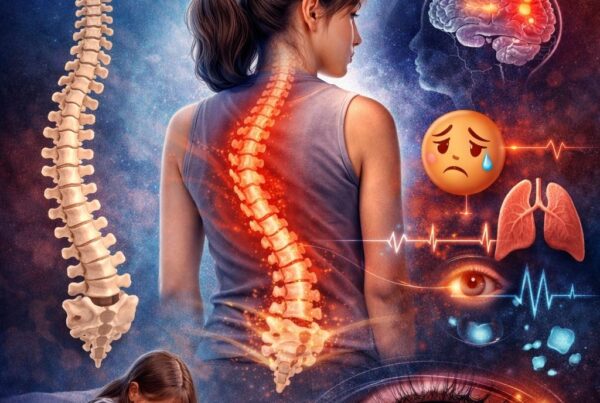
The human spine has a series of natural curvatures in the sagittal plane (side view) in order to maximize biomechanical efficiency, provide shock absorption, and keep the center of gravity within the base of support. One of these curvatures, thoracic kyphosis, represents the physiological outward convexity in the thoracic region. However, when this curvature exceeds a certain degree or loses its flexibility, it transforms into a pathology called “hyperkyphosis,” which has serious aesthetic and functional consequences.[1, 2, 3] In clinical practice, the most frequently asked questions are whether this curvature progresses over time and which individuals are at higher risk for such progression. This report comprehensively examines the structural and functional distinctions of kyphosis, risk factors for progression, and management strategies in light of current academic literature and biomechanical research.[4, 5, 6, 7]
Definition of Kyphosis and Physiological Limits
In a healthy adult spine, the normal range of thoracic kyphosis measured by the Cobb angle is generally accepted as between 20° and 40°, or up to 45° according to some authorities.[5, 8, 9] This curvature is maintained by the shape of the intervertebral discs, the morphology of the vertebral bodies, and the tone of the paraspinal muscles.[1] It is known that this angle tends to increase with aging; after the age of 40, the kyphosis angle increases by approximately 2° to 4° per decade.[1, 10] The diagnosis of hyperkyphosis is made when this angle exceeds the threshold of 45°–50°, and the potential for progression varies depending on the underlying cause.[2, 4, 11]
Sagittal Balance and the Biomechanical Chain
The sagittal balance of the spine is defined by the center of gravity (C7 plumb line) passing over the hip joint and ankle in a standing individual.[12] As the kyphosis angle increases, the body’s center of gravity shifts forward. This initiates a process called a “vicious cycle”: the forward shift of the center of gravity increases compressive loads on the anterior part of the vertebral column, which, if bone quality is low (osteoporosis) or growth is ongoing (Scheuermann), leads to further vertebral wedging and consequently an increase in kyphosis.[1, 13, 14]
Functional and Structural Kyphosis: Key Differences
The first step in evaluating the risk of progression in kyphosis is determining whether the deformity is functional or structural. This distinction is a fundamental factor that directly determines both treatment success and prognosis.[15, 16, 17]
Functional (Postural) Kyphosis: Flexibility and Muscle Imbalance
Functional kyphosis typically develops during adolescence due to poor posture habits, weak back muscles, and lack of physical activity.[11, 18] In this type of kyphosis, there is no structural deformity in the vertebral bones. Its main characteristic is flexibility; when the individual is asked to stand upright or lies supine during examination, the curvature can be completely corrected.[17, 18]
The mechanism of functional kyphosis is often associated with “Upper Crossed Syndrome.” In this condition, the chest muscles (pectoralis major and minor) and upper cervical muscles are tight and shortened, while the scapular stabilizers in the upper back and the deep neck flexors are weak.[13, 19, 20, 21] In modern life, smartphone and computer use (“text neck”) is the main factor triggering this muscle imbalance.[20, 22, 23, 24]
Structural Kyphosis: Morphological Changes and Rigidity
Structural kyphosis results from permanent changes in the bony structures or connective tissues of the vertebral column. These deformities are rigid, meaning the individual cannot correct the curvature voluntarily.[5, 17] The most common forms of structural kyphosis are:
- Scheuermann’s Disease: A developmental deformity seen in adolescents, characterized by vertebral wedging.[2, 5, 25]
- Congenital Kyphosis: Results from formation or segmentation errors during spinal development in utero; usually carries a high risk of rapid progression.[5, 16, 26]
- Age-Related (Osteoporotic) Kyphosis: A hunched posture that develops due to vertebral compression fractures, especially in postmenopausal women.[2, 13, 27]
| Parameter | Functional Kyphosis | Structural Kyphosis |
|---|---|---|
| Spinal Flexibility | Fully flexible; corrects with position.[17, 18] | Rigid; does not correct with position.[5, 17] |
| Vertebral Shape | Normal rectangular structure.[15, 16] | ≥5° wedging.[5, 8, 12] |
| Pain Profile | Usually mild, fatigue-related.[18] | More pronounced, mechanical, and chronic pain.[8, 25] |
| Adam’s Forward Bend Test | Smooth thoracic curvature.[28] | Sharp angulation (gibbus deformity).[17, 25] |
| Risk of Progression | Reversible with exercise.[17, 29] | High progression potential until growth ends.[30, 31] |
Scheuermann’s Disease: A Structural Problem of Adolescence
Scheuermann’s disease (juvenile kyphosis) is the most common cause of structural kyphosis during adolescence and affects between 0.4% and 8% of the population.[5, 31] The condition is usually noticed during the rapid growth period (ages 10–15), and it has been reported to occur more frequently in males than in females (with a ratio ranging from 2:1 to 7:1).[5, 8, 31]
Pathophysiology and Radiological Findings
Although the exact cause of Scheuermann’s disease is unknown, it is thought to result from damage to the growth cartilage of the vertebral endplates due to mechanical stress or hormonal factors.[5, 8] For a radiological diagnosis, the Sorenson criteria are applied: wedging of 5° or more must be observed in at least 3 adjacent vertebrae.[2, 5, 12, 32] Other findings include Schmorl’s nodes, narrowing of the disc space, and irregularities in the endplates.[4, 5, 12]
Does Kyphosis Progress? Risk Factors Determining Progression
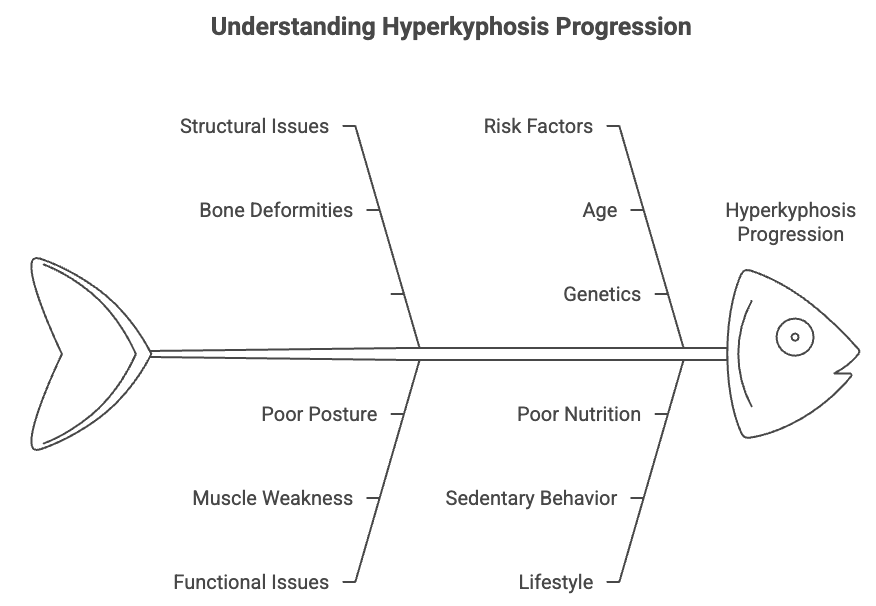
The progression of kyphosis is not a static condition but occurs through the interaction of various biological and mechanical factors. The main determinants of progression risk are skeletal maturity, initial curvature, and genetic predisposition.
Growth Period and Skeletal Maturation (Risser Score)
The risk of kyphosis progression is highest in children with ongoing growth potential. The most commonly used method to assess skeletal maturity is the Risser score (degree of ossification of the iliac apophysis).[31, 33, 34]
- Risser 0–2: High growth potential and therefore the highest risk of progression.[33, 34]
- Risser 3–4: A period when growth slows and the risk of progression decreases.[34]
- Risser 5: The stage at which skeletal maturity is complete and structural progression stabilizes.[30, 33]
Menarche (the first menstrual period) in females is also a critical indicator; the 15 months preceding menarche are considered a “risk window” during which the curvature may progress most rapidly.[33]
Initial Cobb Angle and Critical Threshold Values
The initial degree of the curvature provides important clues about its future course. According to the literature:
- Curvatures below 50° are generally stable and can be well managed with conservative methods.[4, 25]
- Curvatures between 60°–75° carry a high risk of progression if skeletal growth is ongoing and may require bracing.[5, 25, 35]
- Curvatures above 75° may continue to progress at an average rate of 0.3° to 0.5° per year due to the effect of gravity, even after skeletal maturity is reached.[4, 36]
Genetics and Family History
The role of genetics in the development of kyphosis is undeniable. Individuals with a family history of hyperkyphosis have a significantly higher risk.[6, 11, 27, 37] Heritability studies have shown that thoracic kyphosis is determined by genetic factors at a rate of 54% to 61%.[6, 10] In particular, variations in genes related to collagen synthesis, such as COL11A1, have been suggested to be associated with spinal curvature.[10]
Who Is at Greater Risk? Analysis of Special Populations
Risk analysis should not be limited to children but should include individuals at all stages of life. The literature shows that certain populations are more vulnerable to the development and progression of hyperkyphosis.
Adolescents in Rapid Growth Phases
The period of peak height velocity is when the spine is mechanically at its weakest.[30, 33, 38] During this period, if the strength of the back muscles cannot keep up with the rate of bone growth, the spine becomes more prone to bending forward. It has been found that children who are taller than their peers have a higher risk of developing Scheuermann’s disease.[31]
Elderly Population and Geriatric Hyperkyphosis
In older individuals, kyphosis is not only an aesthetic issue but also part of a “geriatric syndrome.”[13, 27] Factors that increase the risk in this population include:
- Osteoporosis and Vertebral Fractures: Low bone mineral density (BMD) leads to vertebral compression fractures, rapidly increasing kyphosis. The risk of progression is 2.7 times higher in women with a vertebral fracture.[13, 14, 27]
- Muscle Loss (Sarcopenia): Loss of volume and strength in the spinal extensor muscles makes it difficult to maintain an upright posture.[13, 27, 39, 40]
- Degenerative Disc Disease: Loss of disc height leads to shortening of the anterior column of the spine.[13, 14, 27]
| Risk Group | Primary Risk Factor | Possible Outcome |
|---|---|---|
| Adolescents (10–15 years) | Rapid growth, Risser 0–2.[30, 33] | Scheuermann’s kyphosis.[5] |
| Individuals with Genetic Predisposition | First-degree relative with kyphosis.[6, 27] | Early and progressive deformity.[37] |
| Sedentary Individuals | Weak core and back muscles.[18, 39] | Functional kyphosis and pain.[2] |
| Osteoporotic Women | Low BMD, compression fractures.[14, 27] | Rapidly progressing kyphosis.[27] |
Systemic Effects and Complications of Kyphosis
Progressive kyphosis can affect not only posture but also vital functions of the body. As the severity of the deformity increases, symptoms become more complex.
Reduced Respiratory Capacity
Excessive flexion of the thoracic spine limits the expansion capacity of the rib cage. When the Cobb angle exceeds 75°, decreases in lung vital capacity and forced expiratory volume (FEV1) begin to be observed.[4, 7, 18, 25] In very advanced cases (>100°), serious cardiopulmonary complications such as cor pulmonale may develop.[4, 25]
Balance Impairment and Risk of Falls
The forward shift of the center of gravity disrupts both static and dynamic balance. In individuals with hyperkyphosis, “postural sway” increases and walking speed decreases.[1] Especially in the elderly, this condition is one of the most important independent risk factors for falls that can lead to fatal outcomes such as hip fractures.[1, 13]
Psychological and Cognitive Effects
Kyphotic posture directly affects an individual’s self-perception and mood. According to the theory known in the literature as “embodied cognition,” a slumped posture is associated with depression, low self-esteem, and increased levels of fear.[41, 42, 43] Conversely, it has been demonstrated that an upright posture reduces cortisol levels and increases feelings of confidence and determination.[42]
Diagnostic and Follow-Up Protocols
Accurate diagnosis is the first step in preventing progression. For parents, observation at home; for professionals, systematic clinical examination is essential.
Clinical Observation and Adam’s Test
The most practical method in school screenings and clinical examinations is Adam’s forward bend test. When the child bends forward, it is checked whether there is a hump on one side of the back (scoliosis) or a sharp angulation in the thoracic region (kyphosis).[5, 25, 28, 44] In addition, forward head posture is evaluated in lateral examination by checking whether the earlobe is aligned with the shoulder.[12, 45]
Radiological Assessment
Definitive diagnosis is made with a standing full-length lateral X-ray. In this assessment, not only the Cobb angle but also the degree of vertebral wedging and skeletal maturity (Risser) are analyzed.[5, 11, 31, 36] In advanced cases, low-radiation systems such as the EOS device, which can display spinal alignment in 3D, may be preferred.[5, 11]
Treatment Approaches and the Importance of Follow-Up
The treatment plan is dynamic and covers a wide spectrum, ranging from a “wait-and-see” policy to surgical intervention.
Physical Therapy and Exercise: The Natural Brace of the Spine
In mild to moderate kyphosis, exercise is the cornerstone of treatment. Strong back muscles are the spine’s most natural brace.[18, 29]
- Schroth Method: A three-dimensional exercise system specifically developed for scoliosis and kyphosis. It aims to reshape the thoracic cage through elongation (spinal lengthening), rotational breathing, and specific muscle activation.[17, 35, 46, 47]
- Strengthening and Stretching: Stretching the pectoral (chest) muscles and strengthening the spinal extensors (multifidus, trapezius) are essential components of a standard rehabilitation program.[13, 19, 23, 47]
- Kinesio Taping: Taping provides proprioceptive input, increasing the individual’s awareness of upright posture. Studies show that taping combined with exercise leads to significant improvements in kyphosis angle.[48, 49]
Bracing: Intervention on Growth Plates
In structural kyphosis (Scheuermann), when the curvature exceeds 55°–60° and the child is still growing, bracing becomes necessary.[5, 18, 25, 30, 31]
- Milwaukee Brace: The classic and most effective brace; includes a neck ring to correct thoracic curves.[25, 31]
- TLSO (Boston) Brace: Used for lower-level (thoracolumbar) curvatures.[5, 25] The success of bracing is directly dependent on wearing time (more than 20 hours per day) and patient compliance.[5, 31]
Surgical Intervention: When Is It Necessary?
Surgery is the last option when conservative methods are insufficient. It is generally indicated for curvatures over 75°, persistent pain, and progressive neurological deficits.[5, 32, 36]
- Posterior Approach: The most commonly preferred method today. The spine is corrected and stabilized (fused) using pedicle screws and rods.[5, 32, 36]
- Ponte Osteotomy: A procedure in which specific parts of the vertebral joints are removed to increase spinal flexibility and enhance correction.[25]
Lifestyle Recommendations for Parents and Professionals
Managing kyphosis requires changes in daily habits beyond clinical treatment.
- Ergonomic Adjustments: Desk and chair height should be adjusted so that elbows are at 90° and feet are flat on the ground. The computer screen should be at eye level.[20, 22, 50]
- Device Use Awareness: Instead of bending the head forward while using a phone or tablet, bringing the device to eye level can reduce spinal load by up to 70%.[20, 23, 50]
- Backpack Guidelines: The weight of the backpack should not exceed 10% of the child’s body weight; straps should be wide and worn on both shoulders.[22, 24, 51]
- Nutrition and Bone Health: Vitamin D and calcium intake should be optimized for vertebral integrity.[24, 29, 37]
Kyphosis is a condition that can be halted and even reversed when diagnosed early and managed appropriately. However, in the presence of a structural disorder (Scheuermann), careful monitoring throughout the growth period is the most important factor preventing the need for surgery.[18, 30, 38, 52] A multidisciplinary approach by both professionals and families is essential for the long-term preservation of spinal health.
References
- The Clinical Relevance of Hyperkyphosis: A Narrative Review – PMC, https://pmc.ncbi.nlm.nih.gov/articles/PMC6993454/
- Kyphoscoliosis – StatPearls – NCBI Bookshelf – NIH, https://www.ncbi.nlm.nih.gov/books/NBK562183/
- Scoliosis and Kyphosis | Musculoskeletal Key, https://musculoskeletalkey.com/scoliosis-and-kyphosis/
- The Natural History of Scheuermann’s Kyphosis – PMC, https://pmc.ncbi.nlm.nih.gov/articles/PMC12538408/
- Scheuermann Kyphosis: Current Concepts and Management – PMC, https://pmc.ncbi.nlm.nih.gov/articles/PMC10587050/
- Heritability of Thoracic Spine Curvature and Genetic Correlations With Other Spine Traits: The Framingham Study – PMC, https://pmc.ncbi.nlm.nih.gov/articles/PMC5282513/
- Postural Correction and Functional Gains in Adults with Kyphotic Progression, https://www.researchgate.net/publication/398490506_Postural_Correction_and_Functional_Gains_in_Adults_with_Kyphotic_Progression
- Scheuermann’s Kyphosis | Scheuermann’s disease by Yanni, https://yannimd.com/scheuermanns-kyphosis/
- Kifoz (Kamburluk) Tedavisi – Prof.Dr.Murat Bezer, https://www.muratbezer.com/kifoz-kamburluk-tedavisi
- Aging of the Spine: Characterizing genetic and physiological determinants of spinal curvature | medRxiv, https://www.medrxiv.org/content/10.1101/2024.02.27.24303450v1.full-text
- Kifoz Nedir? Tedavi Yöntemleri Nelerdir? | Medipol Sağlık Grubu, https://medipol.com.tr/saglik-rehberi/kifoz-nedir-tedavi-yontemleri-nelerdir
- Scheuermann Kifozu, https://www.ftrdergisi.com/pdf.php?&id=2923
- Age-Related Hyperkyphosis: Its Causes, Consequences, and … – jospt, https://www.jospt.org/doi/10.2519/jospt.2010.3099
- Factors Associated With Kyphosis Progression in Older Women: 15 years experience in the Study of Osteoporotic Fractures – PMC, https://pmc.ncbi.nlm.nih.gov/articles/PMC3693545/
- Functional vs. structural scoliosis: A comparison | – Dr Daniel Park, https://www.danielparkmd.com/healthcare-news-pl542/functional-vs-structural-scoliosis-a-comparison-p59616.html
- Kyphosis vs Scoliosis: Key Differences Explained | Chiropractor In Midvale, https://scoliosiscenterofutah.com/kyphosis-vs-scoliosis/
- Schroth Method for Kyphosis, https://schrothdc.com/blog/kyphosis
- Kifoz (Kamburluk) – Prof. Dr. Çağatay Öztürk, https://drcagatayozturk.com/omurga/kifoz-tedavisi-ve-kamburluk/
- Dik Duruş Egzersizleri – / Duyusal Akademi, http://www.duyusalakademi.com/58+dik-durus-egzersizleri-+makale-detay.html
- The Effects of Postural Education or Corrective Exercise on the Craniovertebral Angle in Young Adults with Forward Head Posture: A Randomized Controlled Trial – PMC, https://pmc.ncbi.nlm.nih.gov/articles/PMC10464763/
- Physical Therapy for Postural Alignment and Core Strength – obrienphysicaltherapy.net, https://www.obrienphysicaltherapy.net/blog/physical-therapy-for-postural-alignment-and-core-strength
- Duruş Bozuklukları ve Ergonomi Sağlıklı Bir Yaşam İçin Bilinçli Hareket Etmek, https://www.drkayaturan.org/blog/duru-bozukluklar-ve-ergonomi-nbspsalkl-bir-yaam-in-bilinli-hareket-etmek
- Fizik Tedavi ile Postür (Duruş) Bozukluklarını Düzeltmek Mümkün Mü?, https://www.robotikrehabilitasyonmerkezi.com/blog/fizik-tedavi-ile-postur-durus-bozukluklarini-duzeltmek-mumkun-mu/
- Risk Factors Involved in Postural Disorders in Children and Adolescents – MDPI, https://www.mdpi.com/2075-1729/14/11/1463
- Scheuermann Kifozu – Spinal ve Periferik Sinir Cerrahisi Bülteni, https://www.spinalbulten.com/pdf.php?id=469
- Kyphosis Exercises To Help Reduce Kyphosis & Other Treatment, https://clear-institute.org/blog/kyphosis-exercises/
- Factors Associated with Kyphosis and Kyphosis Progression in Older Men: the MrOS Study – PMC, https://pmc.ncbi.nlm.nih.gov/articles/PMC8849571/
- Spinal Screening Program Guidelines – Texas Department of State Health Services (DSHS), https://www.dshs.texas.gov/sites/default/files/vhs/pdf/Spinal%20Screening%20Manual.pdf%206..6.2023.pdf
- Kifoz (Kamburluk) Tedavisi Nasıl Yapılır? / Bazekol Sağlık Grubu, https://bazekol.com/kifoz-kamburluk-tedavisi
- Scheuermann’s Kyphosis | Nemours KidsHealth, https://kidshealth.org/en/parents/scheuermann-kyphosis.html
- Kyphosis: Diagnosis, Classification and Treatment Methods – Kifoz, https://turkishneurosurgery.org.tr/pdf.php?id=1284
- Treatment approaches for Scheuermann kyphosis: A systematic review of historic and current management, https://pure.johnshopkins.edu/en/publications/treatment-approaches-for-scheuermann-kyphosis-a-systematic-review/
- Factors Related to Curve Progression in Adolescent Idiopathic Scoliosis Girls at Skeletal Maturity – PMC, https://pmc.ncbi.nlm.nih.gov/articles/PMC12651968/
- Does Risser stage accurately predict the risk of curve progression in patients with adolescent idiopathic scoliosis treated with night-time bracing?, https://research.regionh.dk/en/publications/does-risser-stage-accurately-predict-the-risk-of-curve-progressio/
- The effectiveness of Schroth exercises in adolescents with idiopathic scoliosis: A systematic review and meta-analysis – PMC, https://pmc.ncbi.nlm.nih.gov/articles/PMC6556933/
- Scoliosis & Kyphosis – USC Spine Center – Los Angeles, https://www.uscspine.com/conditions-treated/back-disorders/scoliosis-kyphosis/
- The Impact of Genetic vs. Environmental Drivers of Scoliosis, https://treatingscoliosis.com/blog/genetic-vs-environmental-drivers-of-scoliosis-key-insights/
- Screening overview, https://www.choa.org/-/media/Files/Childrens/medical-professionals/scoliosis-screening-resources/preparing-for-scoli-screening_packet-for-school-health_october-2022.pdf
- Associations between Physical Activity and Kyphosis and Lumbar Lordosis Abnormalities, Pain, and Quality of Life in Healthy Older Adults: A Cross-Sectional Study – PMC, https://pmc.ncbi.nlm.nih.gov/articles/PMC10572639/
- Progressive Spinal Kyphosis in the Aging Population – DukeSpace, https://dukespace.lib.duke.edu/bitstreams/bdad202b-491d-4634-9338-daa50e1f621b/download
- Conservative Treatment for Scheuermann’s Kyphosis Case Study, https://esmed.org/conservative-treatment-for-scheuermanns-kyphosis-case-study/
- Hidden Link Between Mental Health + Posture – Dr. Hana Khan – The Neurodivergent Collective, https://theneurodivergentcollective.com/hidden-link-between-mental-health-posture/
- Understanding Embodied Effects of Posture: A Qualitative Study – MDPI, https://www.mdpi.com/2624-8611/5/2/30
- Adolescent Idiopathic Scoliosis: Screening | United States Preventive Services Taskforce, https://www.uspreventiveservicestaskforce.org/uspstf/recommendation/adolescent-idiopathic-scoliosis-screening
- Prevalence of Postural Changes and Musculoskeletal Disorders in Young Adults – PMC, https://pmc.ncbi.nlm.nih.gov/articles/PMC10743088/
- (PDF) The Effect of Schroth Therapy on Thoracic Kyphotic Curve and Quality of Life in Scheuermann’s Patients: A Randomized Controlled Trial – ResearchGate, https://www.researchgate.net/publication/330600015_The_Effect_of_Schroth_Therapy_on_Thoracic_Kyphotic_Curve_and_Quality_of_Life_in_Scheuermann’s_Patients_A_Randomized_Controlled_Trial
- The Effect of Schroth Therapy on Thoracic Kyphotic Curve and …, https://pmc.ncbi.nlm.nih.gov/articles/PMC6547400/
- Modern Methods for Postural Correction: The Impact of Kinesio Taping and Corrective Exercises on Dentists—A Quasi‐Experimental Study – PMC, https://pmc.ncbi.nlm.nih.gov/articles/PMC12426618/
- the effect of postural kinesiotaping in the treatment of thoracic kyphosis – ResearchGate, https://www.researchgate.net/publication/359052342_THE_EFFECT_OF_POSTURAL_KINESIOTAPING_IN_THE_TREATMENT_OF_THORACIC_KYPHOSIS
- Duruş Bozukluğunu Önlemek İçin 8 Kural – Memorial, https://www.memorial.com.tr/saglik-rehberi/durus-bozuklugunu-onlemek-icin-8-kural
- The Interconnected Role of Posture in Student Health, Cognition, and Long-Term Well-being – Zenodo, https://zenodo.org/records/15460333/files/Posture_Health_Cognition_Students.pdf?download=1
- Assessing the accuracy and reproducibility of artificial intelligence-generated medical responses by ChatGPT on Scheuermann’s kyphosis – PMC, https://pmc.ncbi.nlm.nih.gov/articles/PMC12914328/