Introduction
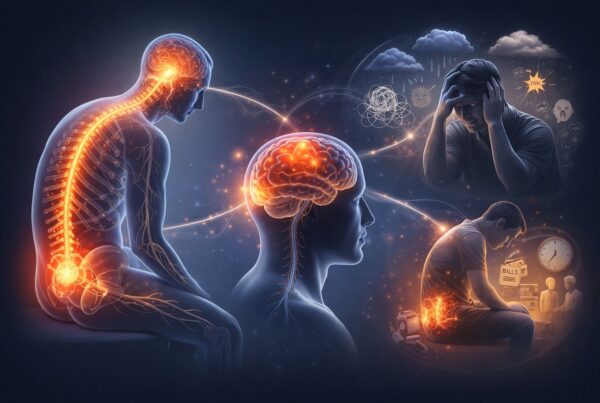
Scoliosis is not merely a lateral curvature of the spine; it is a sophisticated and multi-layered structural reorganization process of the axial skeleton—one of the most complex structures of the human body—occurring in three-dimensional space.[1, 2, 3] Traditionally, especially in school screenings or routine physical examinations, this condition is described on a two-dimensional X-ray image as resembling the letters “S” or “C”; however, this representation actually reflects only the visible part of the iceberg.[4, 5, 6] Advances in modern spine surgery and rehabilitation science reveal that scoliosis is a systemic phenomenon involving rotation of the spine around its own axis, geometric torsion of the rib cage, and profound adaptations in the postural control mechanisms of the central nervous system.[7, 8, 9]
Summary
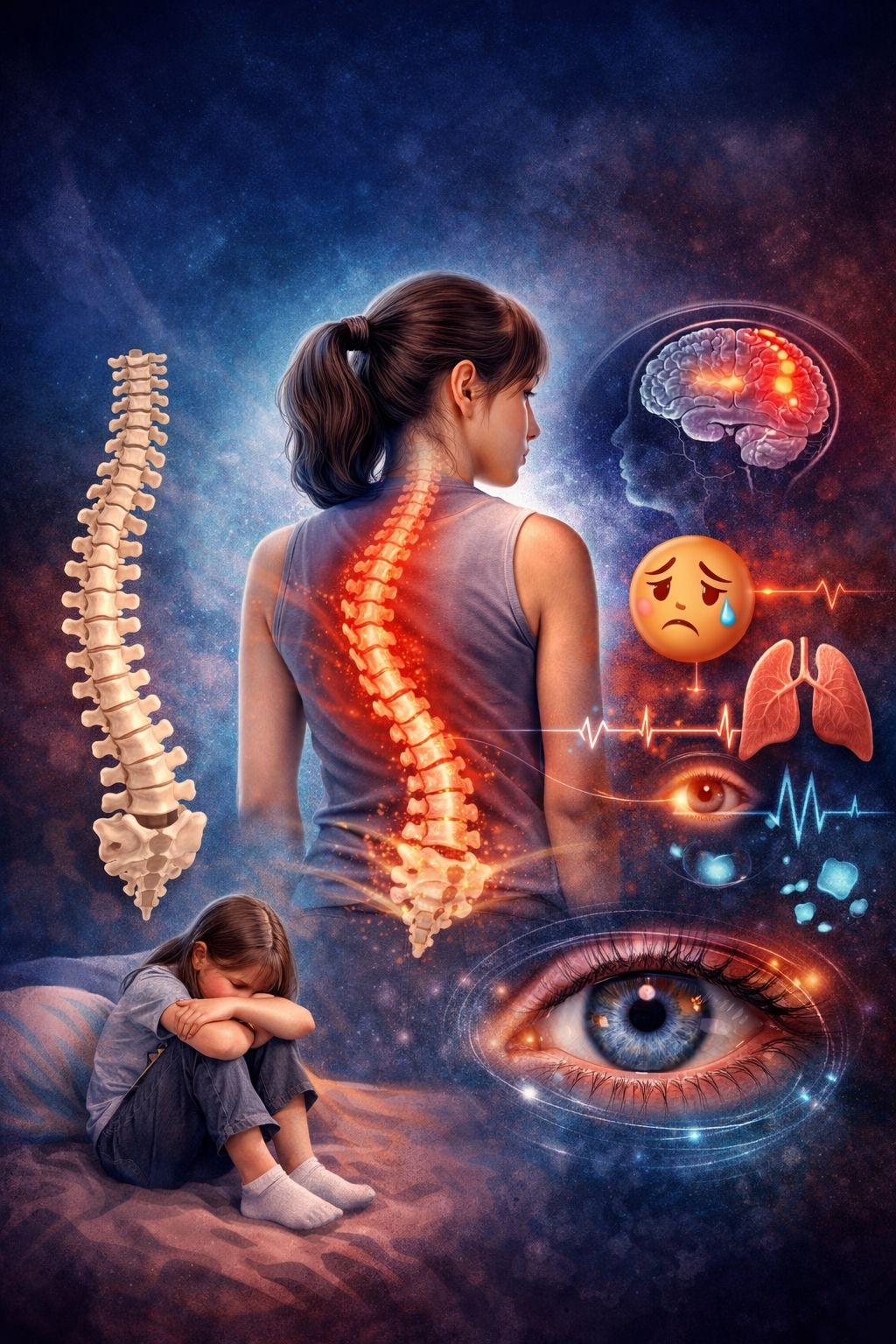
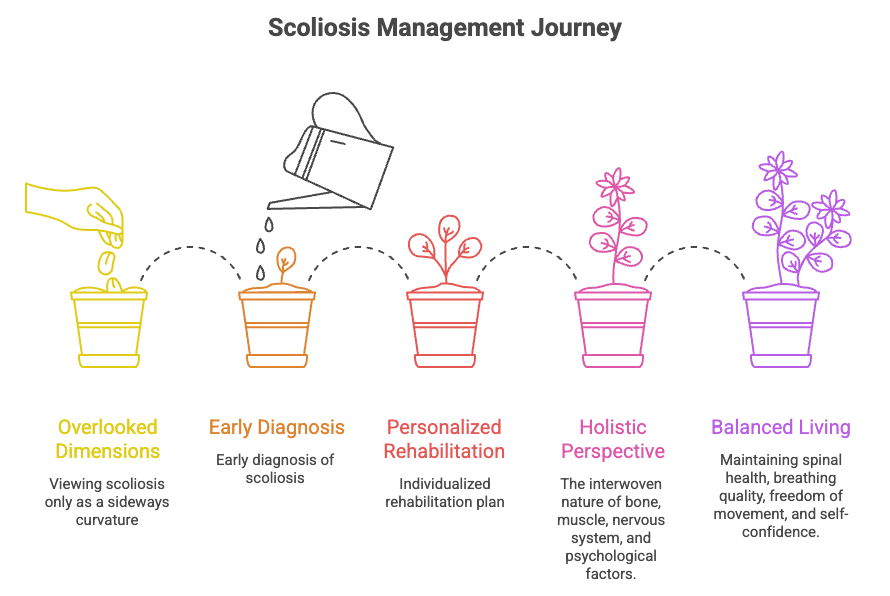
Scoliosis is not a static curve on an X-ray image; it is a dynamic and three-dimensional life experience in which bones, muscles, the nervous system, and psychological factors are interwoven.[1, 8, 37] Scientific studies show that viewing this condition merely as a “sideways curvature” means overlooking the mechanical limitations, neurological adaptations, and psychosocial challenges experienced by the individual.[4, 9, 37]
Modern management strategies place early diagnosis, individualized rehabilitation, and a holistic perspective at the center, aiming to preserve not only spinal health but also breathing quality, freedom of movement, and self-confidence in individuals with scoliosis.[12, 36, 47] Recognizing the “invisible dimensions” of scoliosis is the first step toward a more informed treatment process and a healthier future. Although each individual’s scoliosis journey is different, it is possible to manage this process and maintain a balanced life with the right knowledge and expert support.
The Three-Dimensional Nature of Spinal Deformity and Interplanar Interaction
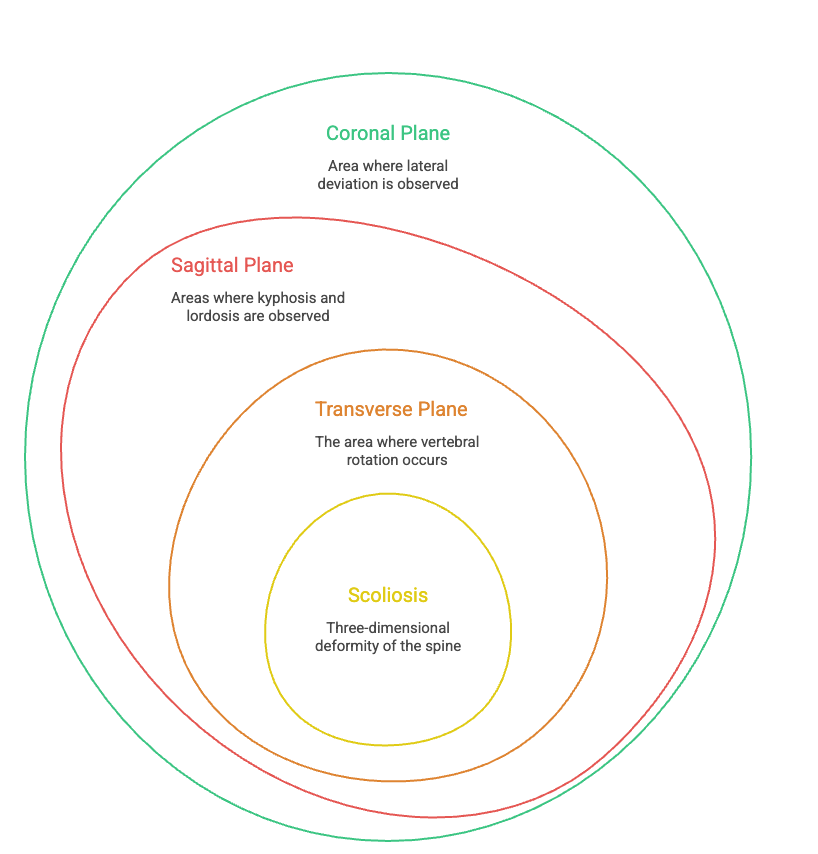
To understand the foundation of scoliosis, the spine should not be considered merely as a column that deviates to the right or left when viewed from the front. The literature defines scoliosis as a deformity that occurs simultaneously in the sagittal, coronal, and transverse planes.[2, 7, 10] These deviations in three planes are not independent of each other; on the contrary, a disruption in one plane directly affects the mechanical balance in the others.[1, 11]
Geometric Planes and the Three-Dimensional Anatomy of Scoliosis
Evaluations made through three main planes in spinal mechanics allow us to understand the true magnitude of the deformity. The coronal (frontal) plane divides the body into front and back and is the area where the most well-known sign of scoliosis, lateral deviation, is observed.[7, 12] The sagittal plane divides the body into right and left; here, changes in the natural curvatures of the spine, kyphosis and lordosis, are observed.[11, 13] The transverse (axial) plane is an imaginary line dividing the body into upper and lower parts and is where vertebral rotation, the most critical component of scoliosis, occurs.[14, 15]
Plane Deformity Characteristic Anatomical and Clinical Reflection Coronal (Frontal) Lateral Deviation Shoulder height difference, pelvic asymmetry, inequality of waist curves Sagittal (Side View) Hypokyphosis or Hyperlordosis Flattening of the back (flat back), decrease or increase in thoracic depth Transverse (Axial) Vertebral Rotation Rib hump, trunk torsion, asymmetry in internal organ positioning
Research suggests that idiopathic scoliosis is not merely a bone curvature, but behaves like the twisting of a flexible wire along which each vertebra is arranged like beads.[7] This modeling shows that the spine behaves like a heterogeneous beam and that each region (cervical, thoracic, lumbar) exhibits its own rotational characteristics.[7]
The Concept of the Plane of Maximal Curvature (PMC)
The concept of the “Plane of Maximal Curvature” (PMC), developed to better understand scoliosis, states that the curvature actually reaches its maximum value not in the coronal plane, but at another angle deviated from this plane due to rotation.[4] For example, a curvature seen as 30 degrees on a patient’s X-ray may actually have a very different and potentially larger angle in three-dimensional space due to spinal rotation.[4, 9] This explains why relying solely on two-dimensional X-rays may be insufficient in clinical evaluation.
Biomechanical Mechanisms of Spinal Rotation and Trunk Asymmetry
The most prominent external sign of scoliosis, the “rib hump,” is a direct result of rotation of the spine in the transverse plane.[16, 17] As the vertebrae rotate around their own axis, they carry along the ribs that are anatomically connected to them.[16, 18] The ribs on the convex side of the curve are pushed backward, creating a noticeable protrusion, while the ribs on the concave side collapse forward, causing the rib cage to take on an asymmetric form.[13, 16, 18]
The Hueter-Volkmann Principle and Structural Progression
The reason why scoliosis progresses rapidly during the growth period can be explained by the “Hueter-Volkmann Law.”[19] According to this biomechanical principle, excessive pressure applied to a growth cartilage slows its growth, while growth accelerates in areas where pressure is reduced.[19] Once the spine begins to rotate and bend laterally in scoliosis, greater load is placed on the vertebral bodies on the inner side of the curve.[19] This causes that side of the vertebra to remain shorter, while the outer side lengthens more, leading the vertebra to take on a “wedged” shape.[19] This mechanism reveals why scoliosis is a self-perpetuating process that can progress if not intervened.
Effects of Trunk Asymmetry on Muscles and Soft Tissue
These three-dimensional changes in the spine and rib cage lead to significant adaptations in the surrounding muscle tissue. Studies show that in scoliosis, especially the abdominal muscles, thoracic extensors, and lumbar muscles are subjected to asymmetric pulling forces.[2, 20] Some muscle groups become chronically shortened and tense, while the muscles on the opposite side may lengthen and weaken.[2, 21] This muscle imbalance not only affects external appearance but also reduces the individual’s movement efficiency in daily life.[6, 21]
Deep Effects on the Respiratory System and Rib Cage
One of the most critical “invisible” dimensions of scoliosis is its effect on respiratory mechanics. The rib cage is not only a protective structure for the lungs but also a dynamic “pump” system that enables breathing.[18] Spinal deformity disrupts the geometry of this pump, potentially restricting the volume required for lung expansion.[16, 18, 22]
Thoracic Insufficiency Syndrome and Early-Onset Scoliosis
Especially in cases that begin before the age of 10 and are defined as “Early-Onset Scoliosis” (EOS), the risks to the respiratory system are more pronounced.[18, 22] Severe deformities occurring within the first 5 years—considered the “golden period” for lung development—can lead to “Thoracic Insufficiency Syndrome” (TIS).[18, 22] TIS is defined as the inability of the thoracic cage to support normal respiration or lung growth.[22, 23]
Respiratory Parameter Effect of Scoliosis Clinical Importance Lung Volume (FVC) Decreases due to rib cage narrowing Becomes significant when curvature exceeds 70–80 degrees Airway Resistance Mechanical bending in bronchi due to torsion May cause shortness of breath during exertion Chest Wall Compliance Rib stiffness and asymmetry reduce flexibility Leads to increased energy expenditure of respiratory muscles (fatigue) Alveolar Development Compression at early ages may prevent formation of new alveoli May permanently affect long-term respiratory capacity
Relationship Between Lung Function and Degree of Curvature
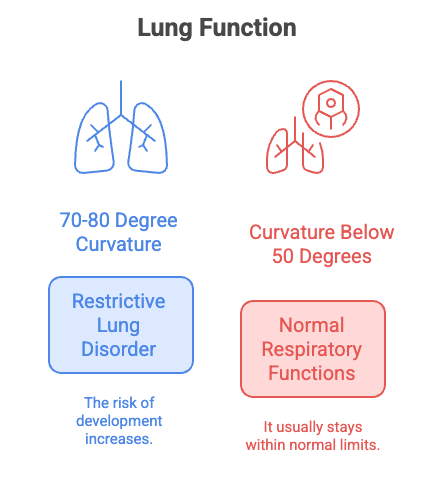
Scientific literature indicates that the decline in lung function generally correlates with the degree of curvature (Cobb angle), although it varies between individuals.[6, 16, 24] As a general rule, respiratory functions usually remain within normal limits in curvatures below 50 degrees, while the risk of developing restrictive lung disease increases in curvatures of 70–80 degrees and above.[16, 24] However, not only the magnitude of the angle but also how much the spine “flattens” (loss in the sagittal plane) is a critical factor for respiration.[4, 13]
Posture, Balance, and Motor Control: A Neurological Perspective
Scoliosis is not only a structural disorder of the bones but also a difference in how the nervous system perceives the body schema.[8, 25] The “proprioception” system, which allows our body to perceive its position in space, reorganizes in individuals with scoliosis due to asymmetric input signals.[25, 26]
Proprioceptive Deficits and Sensorimotor Integration
Studies show that individuals with idiopathic scoliosis may demonstrate differences in position sense and balance tests compared to their healthy peers.[9, 25] The brain begins to accept the asymmetric signals resulting from spinal curvature as “normal.”[26, 27] This is the fundamental phenomenon that causes a person with scoliosis to feel as if they are leaning to one side when told to “stand upright.”[12, 21]
- Balance Strategies: Individuals with scoliosis may rely more on ankle strategies to maintain static balance, while becoming more dependent on inputs from the vestibular (inner ear) system during dynamic tasks.[26]
- Muscle Activation Pattern: The recruitment order of muscles during a loss of balance may be reversed or delayed in individuals with scoliosis.[13, 26]
- Visual Dependency: Some patients may become overly dependent on visual input to compensate for errors in the proprioceptive system; therefore, the risk of losing balance increases in the dark or when the eyes are closed.[8, 9, 25]
Scapular Dyskinesis and Upper Extremity Coordination
The effects of scoliosis are not limited to the trunk; it also alters the position of the shoulder girdle and the scapula.[13] Vertebral rotation causes the scapulae to sit at asymmetric angles on the rib cage.[13, 28] This leads to a movement disorder called “Scapular Dyskinesis,” which can disrupt shoulder mechanics during arm movements and may lead to shoulder pain over time.[13, 29]
Individual Variability: Why Every Scoliosis Story Is Unique
The clinical presentation of scoliosis is as unique as a fingerprint. The use of the term “idiopathic” in the literature emphasizes that a single underlying cause of scoliosis has not yet been identified and that different factors may predominate in each patient.[10, 15, 30]
Effects of Curve Pattern and Location
The location of the curve within the spine (cervical, thoracic, or lumbar) determines both aesthetic appearance and functional outcomes.[28, 31] For example, a curve in the thoracic region may be more noticeable due to rib prominence, whereas a curve in the lumbar region may cause a shift of the pelvis to one side and flattening of the waist contours.[5, 17, 28] In some individuals, the body creates compensatory secondary curves above or below the main curve to maintain the head centered over the pelvis.[6, 30, 32]
Growth Potential and Risk of Progression
The management of scoliosis is directly related to the patient’s biological age and skeletal maturity.[30, 33, 34] Bone maturation, monitored through radiological methods such as the Risser scale, provides clinicians with critical information about the potential progression of the curve.[33, 35] Rapid growth spurts during adolescence represent the period when the spine is mechanically most vulnerable and when deformity progression is most likely to occur.[28, 31, 36]
The Biopsychosocial Approach: Human-Centered Management Rather Than Disease-Centered
Traditional medicine has long focused on treating the “Cobb angle”; however, the modern approach is based on the “Biopsychosocial Model,” which considers scoliosis as an interaction of biological, psychological, and social factors.[37, 38]
Psychosocial Effects and Quality of Life
Scoliosis diagnosed particularly during adolescence can have profound effects on an individual’s body image.[23, 37, 39] Shoulder asymmetry, distortions in how clothing fits, or the necessity of wearing a brace may lead to loss of self-confidence, social withdrawal, and sometimes depressive symptoms in young individuals.[37, 40] Studies show that the quality of life of individuals with scoliosis is closely related not only to the degree of curvature but also to the level of social support they receive and how they perceive their own body.[37, 38, 41]
- Brace and Psychological Adaptation: In adolescents who must wear a brace for most of the day, stress levels may increase due to peer relationships and activity limitations.[33, 37] However, supportive attitudes from family and healthcare professionals improve treatment compliance and psychological resilience.[36, 37]
- Role of the Family: Research shows that a positive and accepting attitude from the mother toward the condition improves the child’s perspective on the treatment process.[37]
Clinical Implications: Modern Approaches in Assessment and Rehabilitation
The multidimensional nature of scoliosis necessitates that assessment and rehabilitation processes also encompass this complexity.[4, 42] The goal of rehabilitation is no longer only to “correct the curve,” but to optimize the individual’s functional capacity and quality of life.[12, 36]
Comprehensive Assessment Tools
A modern scoliosis assessment must go beyond a static X-ray. Methods used in clinical practice aim to capture the three-dimensional asymmetry of the body:
- Surface Topography and Scoliometer: These radiation-free methods allow millimetric tracking of rotational degree of the back and trunk asymmetry.[15, 42]
- Balance and Posturography: Evaluates the nervous system’s postural control ability by measuring weight transfer and sway.[8, 25]
- Functional Tests: Observes how the spine responds during activities of daily living (climbing stairs, sitting, bending).[6, 21, 43]
Three-Dimensional Rehabilitation and Scoliosis-Specific Exercises (PSSE)
International guidelines (such as SOSORT) emphasize the importance of “Physiotherapeutic Scoliosis-Specific Exercises” (PSSE) in scoliosis management.[30, 42, 44] These exercises, unlike general fitness programs, are fully individualized according to the patient’s three-dimensional curve pattern.[12, 45]
Rehabilitation Component Aim and Mechanism Clinical Outcome 3D Self-Correction Learning to actively correct the spine using one’s own muscles Reprogramming incorrect postural perception in the brain Rotational Breathing Expanding collapsed areas of the rib cage from inside to outside through breathing Increased lung capacity and rib cage flexibility Stabilization Strengthening core muscles to maintain corrected position Reduced risk of progression and improved postural endurance Daily Life Integration Transferring corrected posture into work, play, and rest activities Long-term retention and sustainability of treatment outcomes
Systematic reviews show that specific methods such as Schroth, SEAS, and Lyon may be effective in stabilizing the Cobb angle, improving quality of life, and reducing the rate of progression to surgery.[12, 27, 46] The success of rehabilitation in this process is directly related to the patient’s active participation in treatment and the continuity of the program.[36, 45]
References
- Breakthrough in three-dimensional scoliosis diagnosis: significance of horizontal plane view and vertebra vectors – PMC, https://pmc.ncbi.nlm.nih.gov/articles/PMC3036019/
- Journal of Anatolian Medical Research » Makale » Skolyozda Egzersiz Tedavisi – DergiPark, https://dergipark.org.tr/tr/pub/jamer/article/1185713
- Skolyoz Tedavisinde Schroth Terapi ve Kinezyoteyp Uygulamalarının Etkinliği* – DergiPark, https://dergipark.org.tr/tr/download/article-file/3692153
- State of the art of current 3-D scoliosis classifications: a systematic …, https://pmc.ncbi.nlm.nih.gov/articles/PMC4609046/
- A Parent’s Guide to What Scoliosis Is & How It’s Treated – West Tennessee Healthcare, https://www.wth.org/blog/scoliosis-in-children/
- The Impact of Scoliosis on Daily Life – Kmh Health blog – Drkmh, https://www.drkmh.com/blogs/the-impact-of-scoliosis-on-daily-life/
- Three-dimensional reconstructions of Lenke 1A curves – PMC, https://pmc.ncbi.nlm.nih.gov/articles/PMC5796345/
- (PDF) Idiopathic scoliosis and balance – ResearchGate, https://www.researchgate.net/publication/385889914_Idiopathic_scoliosis_and_balance
- Proprioceptive deficits and postural instability in adolescent idiopathic scoliosis: a comparative study of balance control and key predictors – Frontiers, https://www.frontiersin.org/journals/pediatrics/articles/10.3389/fped.2025.1595125/full
- İdiopatik Skolyoz – Türk Nöroşirürji Dergisi, https://norosirurji.dergisi.org/pdf.php?&id=870
- Classification of three-dimensional thoracic deformities in adolescent idiopathic scoliosis from a multivariate analysis – PMC, https://pmc.ncbi.nlm.nih.gov/articles/PMC3252447/
- Physiotherapeutic Scoliosis-Specific Exercise Methodologies Used for Conservative Treatment of Adolescent Idiopathic Scoliosis, and Their Effectiveness: An Extended Literature Review of Current Research and Practice – PMC, https://pmc.ncbi.nlm.nih.gov/articles/PMC9368145/
- Effect of adding proprioceptive neuromuscular facilitation to conventional physiotherapy on scapular balance and shoulder proprioception in adolescents with idiopathic scoliosis: a randomised controlled trial protocol | BMJ Open, https://bmjopen.bmj.com/content/15/11/e106848
- Effect of three-dimensional rotational deformity correction in surgery for adult degenerative scoliosis using lumbar lateral interbody fusion and posterior pedicle screw fixation – PMC, https://pmc.ncbi.nlm.nih.gov/articles/PMC6698552/
- Effects of different physical therapy training protocols on patients with idiopathic scoliosis: Short-term results – PMC, https://pmc.ncbi.nlm.nih.gov/articles/PMC12533888/
- Managing Scoliosis Rib Pain: Lung Function & Breath Impact – ScoliSMART Clinic, https://treatingscoliosis.com/blog/scoliosis-rib-pain-lung-function-shortness-of-breath/
- Patient and family guide to scoliosis – Boston Children’s Hospital, https://www.childrenshospital.org/sites/default/files/media_migration/e256b597-c842-43c9-b8f2-99362d7da05c.pdf
- Effects of spinal deformities on lung development in children: a …, https://pmc.ncbi.nlm.nih.gov/articles/PMC10041811/
- Scoliosis – Sosort, https://sosort.org/wp-content/uploads/2025/04/2008-Book-of-Abstracts.pdf
- İdiyopatik Skolyozda Egzersiz Reçeteleme – Turkish Journal of Physical Medicine and Rehabilitation, https://www.ftrdergisi.com/pdf.php?id=3739
- Living With Scoliosis: What Daily Life Feels Like, https://clearlifescoliosis.com/blog/what-scoliosis-really-feels-like-in-day-to-day-life
- Current Knowledge of Respiratory Function in Early Onset Scoliosis and the Effect of Its Contemporary Surgical Treatment – MDPI, https://www.mdpi.com/2077-0383/15/2/754
- A review of quality of life and psychosocial issues in scoliosis – PubMed, https://pubmed.ncbi.nlm.nih.gov/17173000/
- Skolyozda Egzersi̇z Tedavi̇si – DergiPark, https://dergipark.org.tr/tr/download/article-file/2694700
- Proprioceptive deficits and postural instability in adolescent idiopathic scoliosis: a comparative study of balance control and key predictors – PMC, https://pmc.ncbi.nlm.nih.gov/articles/PMC12198138/
- The role of proprioception in the management and … – Frontiers, https://www.frontiersin.org/journals/rehabilitation-sciences/articles/10.3389/fresc.2026.1806503/full
- Rehabilitation of adolescent idiopathic scoliosis: results of exercises and bracing from a series of clinical studies – SciSpace, https://scispace.com/pdf/rehabilitation-of-adolescent-idiopathic-scoliosis-results-of-3h3cpkv20r.pdf
- Adolescent Idiopathic Scoliosis: Symptoms & Treatments – ScoliCare, https://scolicare.com/adolescent-idiopathic-scoliosis/
- The Effects of Scoliosis on Daily Life and How a Chiropractor Can Help, https://www.clarkchiropractictx.com/blog/1124049-the-effects-of-scoliosis-on-daily-life-and-how-a-chiropractor-can-help_2
- Assessment and Management of Adolescent Idiopathic Scoliosis: From the Perspective of a Physiatrist – PMC, https://pmc.ncbi.nlm.nih.gov/articles/PMC12579992/
- Understanding Childhood Scoliosis: A Parent’s Guide from Detection to Treatment, https://healthcare.utah.edu/the-scope/health-library/all/2024/09/understanding-childhood-scoliosis-parents-guide-detection
- Pediatric scoliosis: What every parent should know – Sanford Health News, https://news.sanfordhealth.org/orthopedics/pediatric-scoliosis-what-every-parent-should-know/
- Adolescent Idiopathic Scoliosis – StatPearls – NCBI Bookshelf – NIH, https://www.ncbi.nlm.nih.gov/books/NBK499908/
- Scoliosis in Kids: Answers to Common Questions That Every Parent Needs to Know, https://www.valleychildrens.org/blog/scoliosis-in-kids-answers-to-common-questions-that-every-parent-needs-to-know
- SCOLIOSIS TREATMENT GUIDELINES – Align Physical Therapy, https://align-pt.com/scoliosis-treatment-guidelines/
- 3 Boyutlu Skolyoz Tedavisi | Omurga Eğriliği İçin Bilimsel Yaklaşım – Nefizyoterapi, https://www.nefizyoterapi.com/3-boyutlu-skolyoz-tedavisi
- Evaluation of quality of life and risk factors affecting quality of life in …, https://pmc.ncbi.nlm.nih.gov/articles/PMC4322590/
- Evaluating measures of quality of life in adult scoliosis: a protocol for a systematic review and narrative synthesis – PMC, https://pmc.ncbi.nlm.nih.gov/articles/PMC8474779/
- Idiopathic scoliosis and quality of life – PubMed, https://pubmed.ncbi.nlm.nih.gov/15456000/
- The Effects of Scoliosis on Daily Life – Sainz Chiropractic, https://sainzchiropractic.com/blog/1141552-the-effects-of-scoliosis-on-daily-life
- Quality of life in adolescents with idiopathic scoliosis: A cross-sectional comparison – PMC, https://pmc.ncbi.nlm.nih.gov/articles/PMC12424470/
- Understanding the 2016 SOSORT Guidelines: A Simple Guide for Practitioners, https://tinyeye.com/blog/understanding-the-2016-sosort-guidelines-a-simple-guide-for-practitioners.php
- Living with Scoliosis: Tips and Tricks for Managing Daily Life, https://atlantascoliosiscenter.com/living-with-scoliosis-management-tips/
- 2016 SOSORT guidelines: orthopaedic and rehabilitation treatment of idiopathic scoliosis during growth – PMC, https://pmc.ncbi.nlm.nih.gov/articles/PMC5795289/
- Skolyoz tedavisinde 3 Boyutlu Schroth Metodu Nedir? Turan&Turan, https://turanturan.com.tr/blog/skolyoz-tedavisinde-3-boyutlu-schroth-metodu-nedir/
- Effects of Structured Physical Therapy on Spinal Alignment in Idiopathic Scoliosis: A 12-Month Prospective Study – MDPI, https://www.mdpi.com/2075-4418/15/21/2747
- Eğitim – Skolyoz Derneği, https://skolyozdernegi.com/egitim/